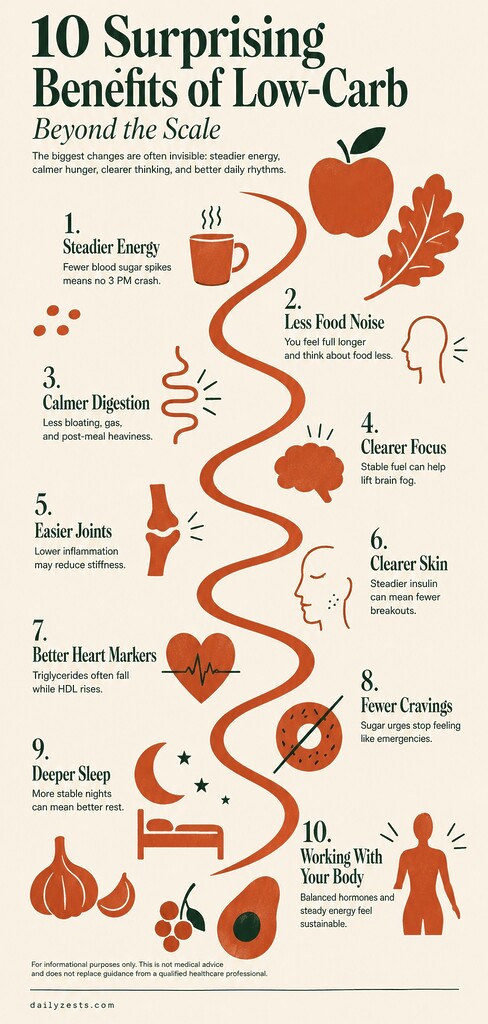
Most people cut carbs because they want their jeans to fit differently. But the real magic of this lifestyle doesn’t happen on a bathroom scale. The changes that actually improve your daily life are almost entirely invisible.
A quick note before we get started: I share this as a researcher and someone who has lived through metabolic frustration, not as a doctor. This is a look at what the science suggests and what finally worked for me. Always check in with your own doctor before making big changes to how you eat.
1. You finally escape the 3 PM energy crash
For years, my afternoons were highly predictable. By 3 PM, I felt like someone had unplugged my battery. I would stare at my computer screen, desperate for a nap, usually relying on another cup of coffee or a sugary snack just to make it to five o’clock.
This was blood sugar instability in action. When you eat a lunch heavy in refined carbohydrates, your blood sugar spikes. Your body responds by pumping out insulin to clear that sugar away, which often results in a sharp blood sugar drop a few hours later. That drop is what causes the infamous afternoon slump.
When you lower your carb intake, your blood sugar stays beautifully steady. Your energy flatlines in the best way possible—you just feel awake, all day long.
2. The constant “food noise” gets turned down
One of the biggest hesitations people have about eating fewer carbs is the fear of feeling restricted. It seems counterintuitive, but eating this way actually tends to create food freedom.
When your blood sugar isn’t swinging wildly from meal to meal, the nagging voice in the back of your head wondering when you get to eat next goes quiet. You eat, you feel full, and then you simply stop thinking about food until you are genuinely hungry again. It is incredibly peaceful to reclaim that mental space.
3. Digestion often quiets down
Many of the carbohydrates standard to an American diet—especially highly processed grains and certain sugars—are fermentable. When they reach your gut, bacteria feast on them, which can lead to uncomfortable bloating, gas, and digestive heaviness.
By shifting your plate away from starches and toward high-quality proteins, healthy fats, and fiber-rich greens, your digestion often becomes much quieter. Your stomach just feels flat and calm after a meal, rather than stretched and working in overdrive.
4. Mental fog starts to lift
If you’ve ever felt like you’re trying to think through a bowl of oatmeal, you know what brain fog feels like.
The brain is an energy-hungry organ. While it can run on glucose, many people find that their focus sharpens noticeably when their brain has access to ketones—a type of fuel your liver produces from fat when carbohydrate intake is very low. Even if you aren’t strictly “keto,” stabilizing your blood sugar prevents the miniature energy crises in your brain that cause you to lose your train of thought mid-sentence.
5. Your joints might feel less stiff
Chronically high insulin levels are closely linked to systemic inflammation. For many people, this inflammation shows up as a dull ache in their knees, stiff fingers in the morning, or a lower back that takes a while to warm up.
Research suggests that a low-carbohydrate lifestyle can be supportive of lowering some markers of inflammation. It’s not uncommon to wake up a few weeks into this transition and realize your ankles don’t creak when you walk down the stairs to feed the dog.
6. Skin can clear up surprisingly fast
Acne and frequent breakouts aren’t just a teenage problem, and they aren’t always about what kind of soap you use. Diet plays a massive role in skin health.
High blood sugar triggers the release of insulin, which in turn can stimulate the production of certain hormones that cause your skin to overproduce sebum (oil). This creates the perfect environment for breakouts. By keeping insulin low and steady, many adults find their skin clears up and takes on a healthier, more even tone without a single change to their skincare routine.
7. Heart health markers often shift favorably
We used to be told that eating fat was the enemy of a healthy heart. But modern science has painted a much more nuanced picture.
When you reduce refined carbs and sugars, routine bloodwork often reveals some positive shifts. Triglycerides (a type of fat in your blood) tend to drop significantly, while HDL (the protective, “good” cholesterol) often goes up. While everyone’s metabolic response is unique, a low-carb approach is increasingly recognized as a useful tool for supporting certain cardiovascular markers.
8. Cravings stop feeling like emergencies
A sugar craving on a high-carb diet feels like a biological emergency. Your hands might shake, you get irritable, and you feel like you need a snack right now.
A craving on a low-carb diet is entirely different. It feels more like a passing thought. You might see a donut in the breakroom, acknowledge that it looks good, and then just walk away without a second thought. You are no longer driven by the physical panic of dropping glucose.
9. Sleep becomes deeper and more restorative
Waking up at 2 AM with your heart racing can sometimes be a sign of blood sugar instability, especially if you’re prone to overnight lows. If your glucose drops too low in the middle of the night, your body releases cortisol and adrenaline to bring it back up. Those stress hormones can wake you up.
Once you step off the blood sugar rollercoaster, your nights tend to smooth out. You fall asleep easier, stay asleep longer, and wake up feeling like you actually rested.
10. You stop fighting your own body
Perhaps the most profound benefit of all is a shift in perspective. So much of standard diet advice feels like a battle: eat less, push harder, ignore your hunger, rely on willpower.
Lowering your carbohydrates isn’t about white-knuckling your way through the day. It’s about giving your body the right information so it can finally relax. When your hormones are balanced and your energy is steady, you start working with your biology instead of constantly trying to outsmart it. And that is a really good place to live.
Kristina Hanson is an independent wellness researcher and the founder of DailyZests. She specializes in translating nutritional science into simple, delicious recipes that fit into real life. When she isn’t in the kitchen, you’ll find her hiking the trails or enjoying a slow morning coffee with her Golden Retriever, Barnaby. Read her full story.



 This post may contain affiliate links.