You decide to cut back on sugar and starch. Ten minutes of internet research later, you are staring at a screen full of macro calculators, conflicting rules, and shouting influencers. Let us step back and look at what these approaches actually are, without all the noise.
I remember the daily 3 PM blood sugar crash vividly. My energy would plummet, and I would desperately need a nap or a sugary snack just to get through the rest of the afternoon. When I finally began reading the research on how insulin resistance was driving that cycle, I realized changing my food was not about punishing myself. It was about giving my body a necessary break.
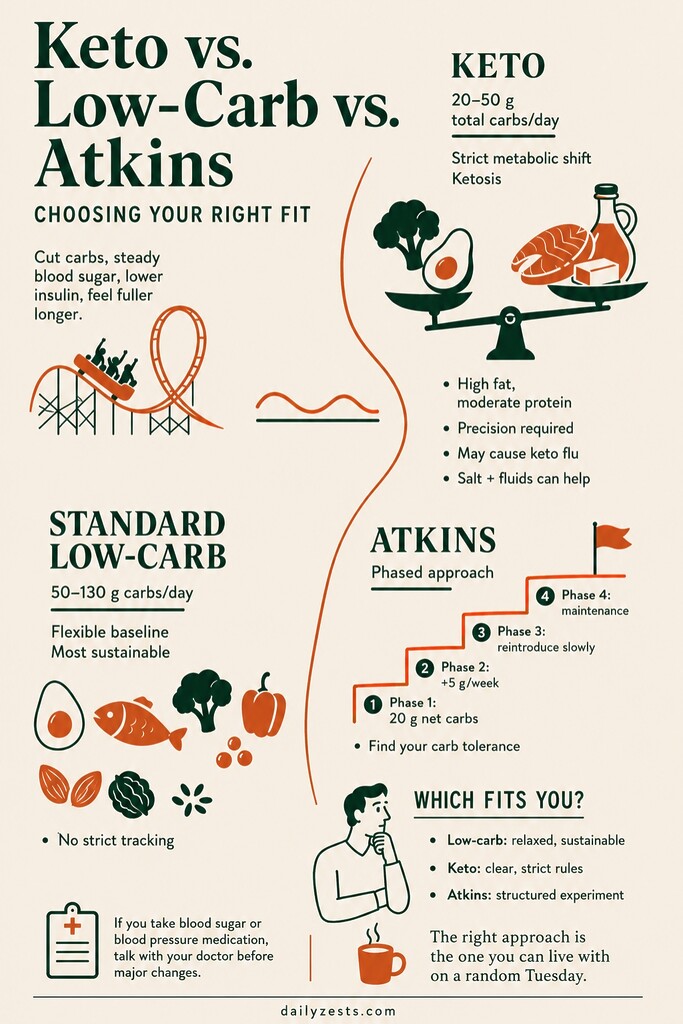
When you eat fewer carbohydrates, your body stops riding a blood sugar rollercoaster. You produce less insulin, your energy stabilizes, and you often feel naturally full for hours. That is the foundational mechanism behind every carb-restricted approach.
The differences between keto, Atkins, and standard low-carb simply come down to how low you go and how closely you track your food. If you take medication for blood sugar or blood pressure, have a quick chat with your doctor before making major changes. Lowering your carbohydrates can require adjusting certain dosages, which is an excellent problem to have, but one you need a medical professional to manage.
Standard Low-Carb: The Flexible Baseline
A standard low-carb approach is the easiest place to start. There is no official textbook defining it, but most researchers consider a diet low-carb if you eat between 50 and 130 grams of carbohydrates per day. For context, the average American diet still gets nearly half of its calories from carbohydrates.
You are removing obvious sugars, bread, pasta, and conventional baked goods. You are replacing them with meat, fish, eggs, healthy fats, and large amounts of above-ground vegetables. You also have plenty of room for berries, nuts, and perhaps a small portion of root vegetables or beans.
This is usually the most sustainable choice for long-term health. You do not need to log every bite into an app. You can go to a restaurant, order a burger without the bun and a side salad, and know you are staying on track. Your body transitions to burning fat more efficiently, but you are not forcing it into a strict metabolic state.
Keto: The Strict Metabolic Shift
The ketogenic diet takes carbohydrate restriction to its absolute limit. To successfully follow keto, you typically consume fewer than 20 to 50 grams of total carbohydrates a day. The remaining calories come heavily from dietary fat and a moderate amount of protein.
The goal is a specific biological state called ketosis. When dietary carbohydrate is incredibly scarce, your liver begins breaking down fat into molecules called ketones, which your brain and body use for fuel. Many find that once they adapt to ketosis, their appetite vanishes and their mental clarity sharpens significantly.
The friction with keto is the precision it requires. You have to read every label. An accidental serving of hidden sugar in a restaurant dressing can bump your body out of ketosis, sending you back to square one. In the beginning, as your body flushes out stored water and sodium, you can experience a temporary grogginess known as the keto flu. You may need to use more salt and fluids to combat this, unless your doctor has told you to limit sodium.
Atkins: The Phased Approach
Atkins has been around for decades, and the original books are still sitting on millions of household shelves. Unlike standard low-carb or keto, Atkins is broken into distinct phases.
You begin in Phase 1, called Induction. This phase restricts you to 20 grams of net carbs a day, making it almost identical to keto. After two weeks, you enter Phase 2 and begin adding 5 grams of net carbs back into your daily meals each week. You slowly introduce nuts, seeds, and berries. In Phase 3, you add starchy vegetables and whole grains back in tiny increments until weight loss stops. Phase 4 is your lifetime maintenance level.
Atkins feels a bit dated to some people. Actually, I think its phased structure is incredibly smart for figuring out your personal carbohydrate tolerance. It removes the guesswork. You learn exactly how many carbohydrates your body can handle before the brain fog or the afternoon fatigue returns, even if you choose to skip the branded snack bars in the grocery aisle.
Making Your Decision
Choosing between a keto vs low carb vs Atkins lifestyle depends entirely on your personality and your daily obligations. A diet only works if you can actually live with it.
Choose standard low-carb if you prefer a relaxed approach to eating. It offers immense benefits for stable energy and weight management without the stress of tracking macros. You can eat generous portions of vegetables and enjoy a handful of fruit without anxiety.
Choose keto if you thrive on clear, strict rules. Some people find moderate boundaries too tempting to push. If you need a firm line in the sand, or if you are specifically looking for the deep appetite suppression that ketosis provides, this is your path.
Choose Atkins if you like structured experiments. It gives you a clear roadmap to discover your exact metabolic threshold, systematically testing foods to see how they impact your body.
Tomorrow morning, when Barnaby and I head out to the porch, I will be enjoying my coffee without logging the heavy cream into an app. I spent years fighting my body’s signals before I realized food is meant to support our days, not complicate them. The right approach is simply the one that lets you feel good in your own skin on a random Tuesday.
Kristina Hanson is an independent wellness researcher and the founder of DailyZests. She specializes in translating nutritional science into simple, delicious recipes that fit into real life. When she isn’t in the kitchen, you’ll find her hiking the trails or enjoying a slow morning coffee with her Golden Retriever, Barnaby. Read her full story.


 This post may contain affiliate links.