When you have PCOS, standard fitness advice often feels designed for a different body entirely. You push harder, sweat more, and somehow just end up exhausted. Here is what I learned when I finally stopped fighting my body and started listening to it.
For years, my approach to managing my PCOS was simple: outwork it. If I was tired, I pushed through. If my body felt heavy, I signed up for a harder boot camp class. I thought that if I just applied enough force, my body would eventually fall into line.
It didn’t.
Instead, I lived in a state of chronic exhaustion. It took stepping back and digging into the research to realize that my workout routine wasn’t fixing my symptoms: it was actually aggravating them. The fitness industry is built on a “no pain, no gain” mentality, but a body with Polycystic Ovary Syndrome requires a different kind of conversation.
If your workouts are leaving you drained instead of energized, you might be falling into a few common traps. Let’s look at three standard exercise habits that often backfire for us, and how to shift them into movements that actually feel supportive.
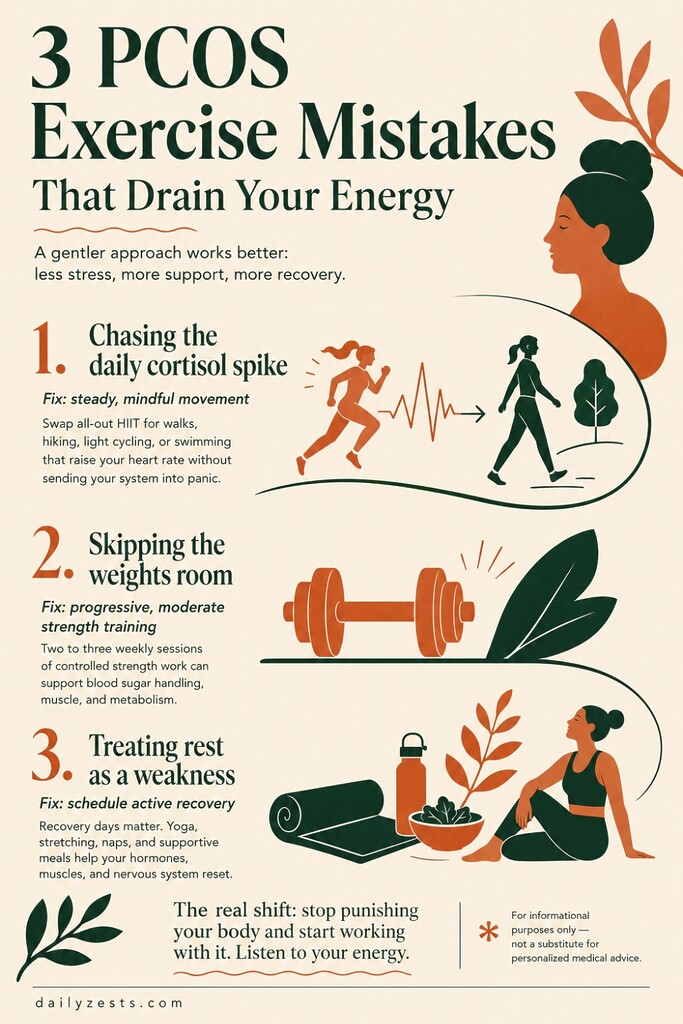
Mistake 1: Chasing the daily cortisol spike
Standard fitness advice loves high-intensity interval training (HIIT). We are constantly told that to see results, we need to be breathless, dripping in sweat, and pushing our heart rates to the absolute limit every single day.
Here is why: Some research suggests women with PCOS may have higher cortisol activity, although it is not the same for everyone. When we add the severe physical stress of a frantic, high-intensity workout on top of an already stressed system, the body can perceive it as an emergency. Research suggests that keeping cortisol chronically elevated can actually disrupt sleep, increase fatigue, and make our bodies hold onto everything tightly.
The Fix: Embrace steady, mindful movement
You do not have to stop sweating, but you might want to stop sprinting. Switching to low-intensity steady state (LISS) cardio was a revelation for me, and research has not found one intensity to be clearly superior for everyone.
Instead of a punishing 6 AM circuit, my mornings now start slowly on the porch with my Golden Retriever, Barnaby, followed by a brisk walk around the neighborhood. Hiking, light cycling, and swimming are beautiful ways to get your heart rate up without sending your nervous system into a panic. Building these softer movements into your routine is one of the most effective daily habits to manage your symptoms naturally.
Mistake 2: Skipping the weights room
It is incredibly common to stick exclusively to the treadmill or the elliptical machine. Sometimes it’s because the weight room feels intimidating, and sometimes it’s because we’ve been incorrectly taught that cardio is the only way to manage our health.
Here is why: Muscle tissue acts a bit like a sponge for blood sugar in the body, a simple way to think about the research. When we build lean muscle, we are essentially building a larger, more efficient system for processing energy. For a body dealing with PCOS, having that extra metabolic support is invaluable.
The Fix: Progressive, moderate strength training
You don’t need to become a powerlifter to see the benefits. Two to three days a week of moderate strength training, close to what current guidance recommends for muscle-strengthening movement, can completely shift how your body feels.
Start small. Use a pair of dumbbells in your living room, or try bodyweight exercises like squats, lunges, and modified push-ups. Focus on slow, controlled movements rather than rushing through reps. If you are frustrated by how your body is responding to exercise, prioritizing muscle over miles is one of the most reliable strategies to support your metabolism.
Mistake 3: Treating rest as a weakness
The “no days off” mentality is a fast track to burnout for anyone, but for women with PCOS, it is especially draining. I used to feel incredibly guilty if I took a day off, viewing rest as a failure of discipline.
Here is why: Exercise is a stimulus, but rest is when the actual magic happens. Recovery time is when your hormones have a chance to settle, your muscles repair, and your nervous system resets. Without adequate rest, research suggests you can push your body toward persistent stress and inflammation.
The Fix: Schedule active recovery
Look at your rest days as an active and necessary part of your health routine, not as a break from it.
Try swapping a workout day for a restorative yoga session, a slow stretching routine, or simply taking an afternoon nap if that is what your body is asking for. Recovery isn’t just about what you do, either; it is about how you fuel yourself. Pairing a solid rest day with supportive meals gives your body the raw materials it needs to repair.
Moving Forward with Kindness
The biggest shift in my own journey wasn’t a specific exercise move or a brand new piece of equipment. It was the decision to stop punishing my body for having PCOS, and to start working with it instead.
If you are feeling overwhelmed, start by picking just one of these shifts. Swap one intense workout for a walk. Pick up a set of light weights. Or, simply permit yourself to take a real, guilt-free day off. If you need a simple framework to help organize these supportive habits, the guide below is a wonderful place to begin.
Listen to your energy levels. They are telling you the truth.
A quick note from one friend to another: I am a researcher and a fellow PCOS traveler, not a doctor. I share what has worked for me and what the research suggests, but please always check in with your own healthcare provider before making major changes to your fitness routine. Your body is uniquely yours.
Kristina Hanson is an independent wellness researcher and the founder of DailyZests. She specializes in translating nutritional science into simple, delicious recipes that fit into real life. When she isn’t in the kitchen, you’ll find her hiking the trails or enjoying a slow morning coffee with her Golden Retriever, Barnaby. Read her full story.


 This post may contain affiliate links.