Years ago I spent most of my afternoons fighting off a wave of absolute exhaustion. My energy was entirely unpredictable. I blamed stress and a busy schedule, but the actual culprit was quietly sitting in my digestive tract. Shifting to a gut-friendly lifestyle changed how my whole body felt, and it did not require throwing away everything in my pantry.
Most of the popular advice around gut health lifestyle changes focuses heavily on subtraction. We are told to cut out dairy, remove gluten, and avoid sugar at all costs. But true digestive support is usually about what you add to your day, rather than what you take away. You just need a few reliable habits to get things moving in the right direction.
Building a routine that supports your digestion is a quiet process. You do not need to overhaul your entire life by Monday. Pick one or two of these habits to practice this week, and let your body adjust at its own pace.
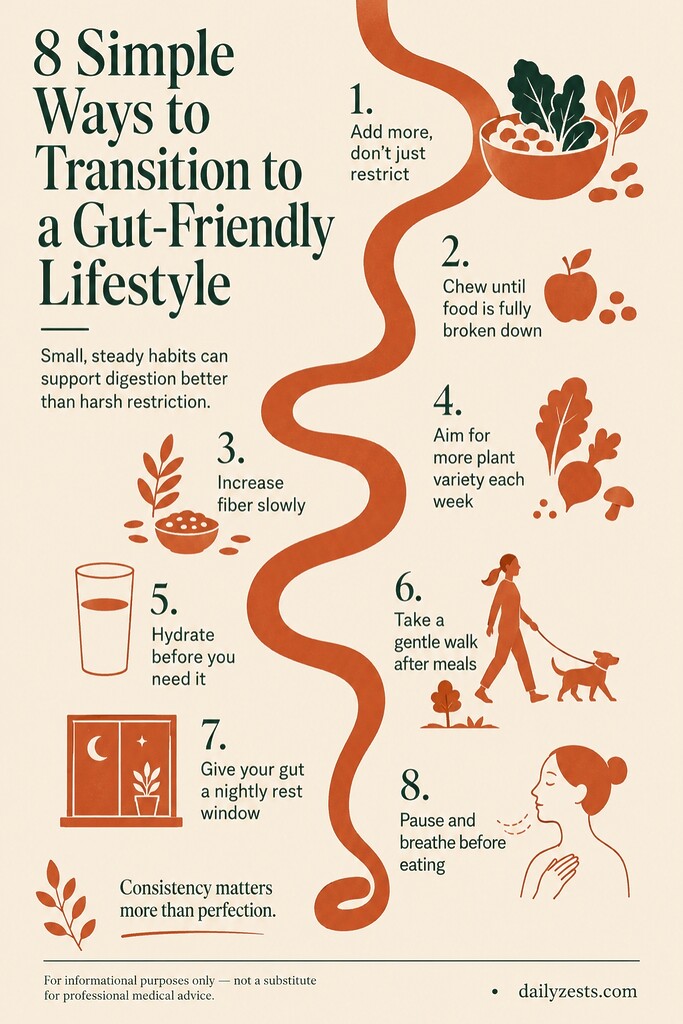
1. Focus on adding, not restricting
The fastest way to burn out on any new health routine is to focus entirely on deprivation. When you tell yourself certain foods are completely forbidden, your brain naturally fixates on them. This creates unnecessary stress, and stress is notoriously hard on your digestion.
Instead of stripping your diet down to plain chicken and steamed broccoli, look for opportunities to add beneficial foods to the meals you already enjoy. If you are having a bowl of pasta, toss in a handful of spinach or some roasted zucchini. If you love yogurt in the morning, top it with chia seeds and sliced almonds. A gut-friendly lifestyle thrives on abundance and variety.
2. Chew your food until it becomes a liquid
This sounds almost too simple to be a real step. But digestion literally begins in your mouth. Your saliva contains enzymes that break down carbohydrates before they ever reach your stomach. If you swallow your food after only three or four bites, you are handing your stomach a massive amount of extra work.
Try putting your fork down between bites. It feels unnatural at first if you are used to eating while answering emails or driving. Take the time to chew until the food loses its texture entirely. Taking this pressure off your stomach can significantly reduce afternoon bloating and that heavy, sluggish feeling after a meal.
3. Ease into fiber very slowly
It happens all the time. Someone decides they want to improve their gut health, so they eat a massive bowl of lentil stew for lunch and a huge kale salad for dinner. By 8 PM, they are bloated, uncomfortable, and convinced that healthy food just does not agree with them.
Your gut bacteria need time to adapt to new materials. Actually, that requires a small asterisk. It is not just about time, but also about hydration. Fiber acts like a sponge in your digestive tract, and if you increase your fiber without increasing your water intake, everything simply stops moving. Gradual introduction over a few weeks allows your gut microbiota and digestive tract to adapt. Start by adding just a quarter cup of beans or an extra serving of vegetables to your day, and stay at that level for a week before adding more.
4. Count your plants over the week
Current research suggests that one of the clearest dietary predictors of a more diverse gut microbiome is the diversity of plants in your diet. Eating the exact same three vegetables every single day is better than eating none, but your beneficial bacteria thrive on variety.
A great goal is to aim for thirty different plant foods over the course of a week. That number sounds intimidating until you realize what counts. Nuts, seeds, whole grains, herbs, and even the cinnamon you sprinkle on your oatmeal all count toward your total. Buying a mixed bag of frozen berries instead of just strawberries instantly gives you three or four different plants in one scoop.
5. Hydrate before you need it
Your digestive tract relies on a mucosal lining to keep things functioning smoothly and to protect your system from irritation. Without enough water, that lining cannot do its job properly. Dehydration is one of the most common, yet overlooked, causes of a sluggish gut.
Try drinking a large glass of water about twenty minutes before you eat. This supports your digestive system and helps keep things moving, especially as your fiber intake rises. Keep a water bottle nearby throughout the day so you can take small sips rather than trying to chug three glasses at dinner.
6. Move gently after a meal
Intense cardio right after lunch will pull blood away from your digestive organs and send it to your muscles. But a quiet, unhurried walk does the exact opposite. Light movement helps stimulate the muscles of your digestive tract, gently encouraging food to move through your system.
Ten minutes is plenty. After dinner, I like to take my golden retriever, Barnaby, for a slow loop around the neighborhood. We do not walk fast, and we stop at every interesting tree. It is just enough movement to settle my stomach and signal to my body that the active part of the day is winding down.
7. Give your gut a clear resting window
Just like your brain, your digestive system uses the night to clean house. There is a specific mechanism in your gut called the migrating motor complex. Think of it as a street sweeper that moves through your digestive tract, clearing out residual food and bacteria. It only activates when your stomach is empty.
If you are constantly snacking late into the night, that cleaning process never fully happens. Try to close your kitchen two or three hours before you go to sleep. You will likely wake up feeling lighter and much more ready for breakfast.
8. Notice how you feel before you eat
The gut and the brain are in constant communication. If you sit down to eat while you are incredibly stressed, angry, or anxious, your body is in a state of fight or flight. In this state, digestion is considered non-essential, and the entire process slows down to a crawl.
You cannot eliminate stress from your life entirely. But you can create a buffer right before a meal. Take three deep, slow breaths before you pick up your fork. Acknowledge whatever is stressing you out, and mentally set it aside just for the next twenty minutes. Your food will digest completely differently when your nervous system feels safe.
Taking the First Step
Transitioning to a gut-friendly lifestyle is not about achieving perfect dietary compliance. It is about learning to listen to the subtle signals your body sends you every day. Tomorrow morning, try taking a few deep breaths before breakfast, or add one new type of seed to your routine. Small, consistent choices always outperform perfect, temporary restrictions.
Kristina Hanson is an independent wellness researcher and the founder of DailyZests. She specializes in translating nutritional science into simple, delicious recipes that fit into real life. When she isn’t in the kitchen, you’ll find her hiking the trails or enjoying a slow morning coffee with her Golden Retriever, Barnaby. Read her full story.



 This post may contain affiliate links.