We spend a lot of energy worrying about the visible signs of getting older. But some of the most important aging happens quietly inside our digestive tract. When our gut loses its natural resilience, we tend to feel it in our daily energy levels, our focus, and how our clothes fit after a meal.
Most of us end up eating the exact same five or six vegetables every single week. We buy the same spinach, the same baby carrots, and the same broccoli. While those are entirely good choices, a healthy microbiome thrives on variety.
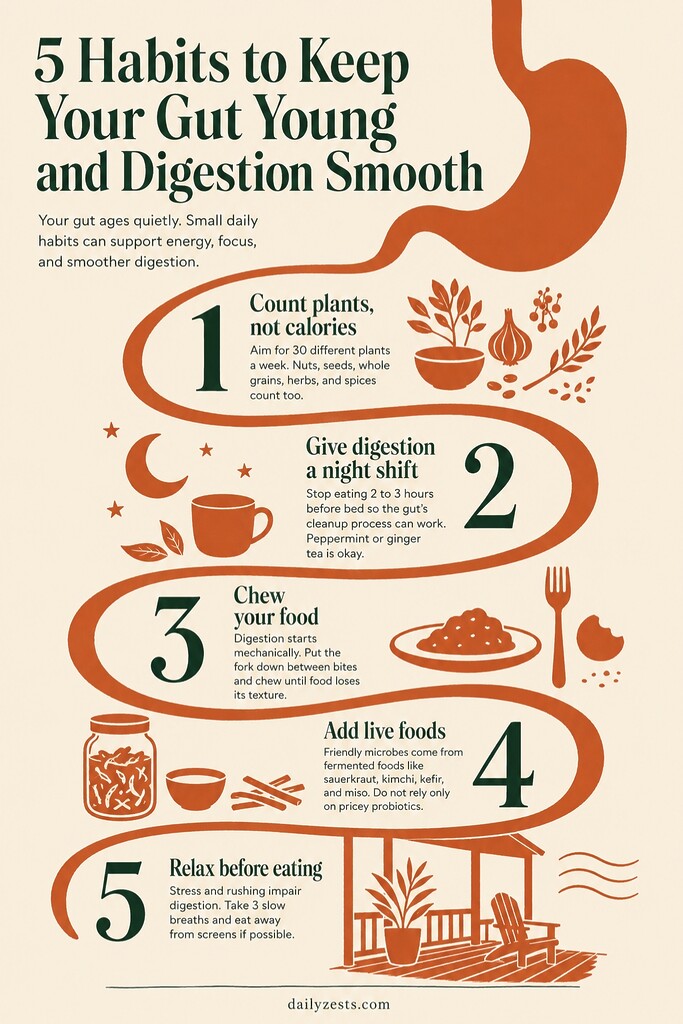
Research points to a fascinating benchmark for greater gut diversity. People who eat thirty different types of plants a week tend to have a more diverse gut microbiome. You might be worried that you do not have the time or energy to track every single almond or basil leaf you consume. I understand that hesitation completely.
But a “plant” is not just a salad green. It includes nuts, seeds, whole grains, herbs, and spices. A pinch of cinnamon on your oatmeal counts. The sesame seeds on your bread count. Adding a sprinkle of pumpkin seeds and a handful of blueberries to your morning yogurt gets you four points before you even leave the house.
2. Give your digestion a dedicated night shift
We often treat our stomachs like an engine that should always be running. But your digestive tract actually needs long stretches of quiet to clean house.
When you stop eating for a few hours, a process called the migrating motor complex turns on. Think of it as a street sweeper for your intestines. It pushes leftover food, debris, and excess bacteria downward. If you are constantly grazing or snacking right up until you fall asleep, that sweeper never gets a chance to do its job. Over time, this can leave you feeling sluggish and uncomfortably full the next morning.
Try closing the kitchen two to three hours before bed. If you need something warm in the evening, a cup of peppermint or ginger tea is a wonderful way to signal to your body that the workday of digesting is over.
3. You have to chew your food
This is the most overlooked of all gut health tips. Your stomach does not have teeth.
Digestion is a mechanical process before it is a chemical one. If you swallow large, unchewed pieces of food, your stomach acid has to work overtime to break them down. This often leads to that heavy, brick-in-the-stomach feeling after lunch.
I know the common advice is to chew every bite thirty times. That is incredibly tedious. Instead, try this simple setup. Put your fork completely down on the table between bites. Do not hover it near your mouth. Just chew your food until it loses its original texture. It costs zero dollars, requires no supplements, and takes an extra three minutes a meal.
4. Stop completely sanitizing your plate
We grew up in an era that feared bacteria. We wash, peel, and scrub everything until it is sterile. While basic food safety is absolutely necessary, our immune systems and our gut lining depend on exposure to friendly microbes.
Actually, let me backtrack slightly. It is not just about eating dirt, though having an organic garden and getting your hands in the soil is wonderful for you. It is about intentionally consuming live foods.
I personally believe most expensive probiotic supplements are a waste of money if you are ignoring fiber and fermented foods. Foods like unpasteurized sauerkraut, kimchi, kefir, and miso are packed with living cultures that temporarily visit your digestive tract to help regulate the environment. A single forkful of raw sauerkraut mixed into a salad adds a massive dose of beneficial microbes.
5. Notice where you hold your tension
For years, I dealt with a heavy, unshakeable fatigue. I tried changing my diet a dozen times before I finally realized my gut and my stress levels were locked in a constant argument.
Your brain and your gut are connected by the vagus nerve. When you are rushing, stressed, or eating while scrolling through stressful news, your body shifts into a sympathetic state. In this state, your body pulls blood away from your digestive organs. You may not digest your food as smoothly when you are tense.
Before you eat, take three very deep, slow breaths. It sounds too easy to work, but it physically signals your nervous system that you are safe enough to rest and digest. Taking your food outside to the porch, away from your screens, can change how your body processes the entire meal.
Keeping your digestion working well is rarely about extreme restriction. It is mostly about giving your body the raw materials it needs and the quiet time it requires to sort through them. Choose one small habit from this list for tomorrow, and see how your body responds.
Just a brief note: I share my own research and what has supported my body over the years. This is not medical advice. Always check with your doctor before making major changes to your health routine.
Kristina Hanson is an independent wellness researcher and the founder of DailyZests. She specializes in translating nutritional science into simple, delicious recipes that fit into real life. When she isn’t in the kitchen, you’ll find her hiking the trails or enjoying a slow morning coffee with her Golden Retriever, Barnaby. Read her full story.



 This post may contain affiliate links.