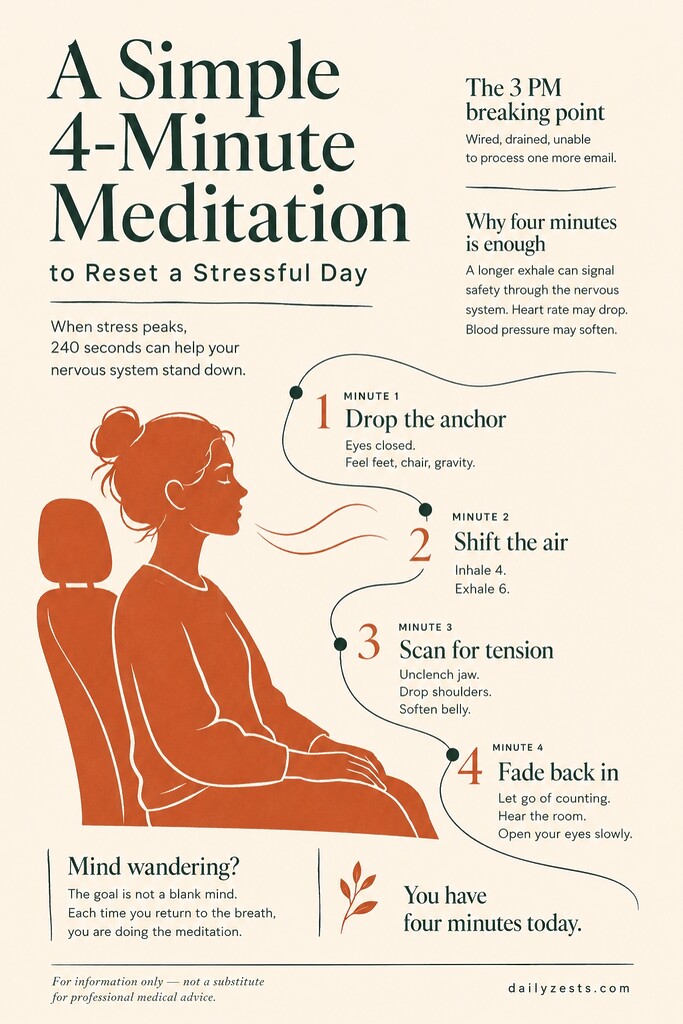
I used to think clearing my head meant sitting on a special floor cushion for thirty minutes while my to-do list screamed at me from the kitchen. Then I learned what the nervous system can actually do in just two hundred and forty seconds.
Years ago, when I was struggling through a long season of chronic fatigue, my afternoons hit a very specific wall. Right around 3 PM, the exhaustion and daily stress would tangle together into a tight knot behind my ribs. I would stare at my computer screen feeling completely wired, yet too physically drained to process a single new email.
I thought the answer was pushing through or pouring another cup of coffee. It took me a long time to realize my body just needed a signal that it was allowed to pause.
You do not need an empty house or absolute silence to find that pause. A short meditation for stress does not require perfection. It just requires a tiny pocket of time where you stop asking your brain to solve problems.
Why four minutes is enough
It sounds almost too brief to matter. But physiology moves faster than we think.
Research suggests that taking just a few minutes to intentionally lengthen your breath stimulates the vagus nerve. That nerve acts as a communication highway between your brain and your body. When you slow your breathing down, you are sending a physical message up to your brain that the environment is safe. Heart rate can drop. Blood pressure may soften. Your stress response gets a chance to quiet down.
You are not trying to reach enlightenment. You are just giving your nervous system permission to stand down for a moment.
How to do the 4-minute meditation
You can do this sitting at your desk, parked in your driveway before walking into the house, or sitting on the edge of your bed. Just set a timer on your phone for four minutes so you do not have to worry about watching the clock.
Minute 1: Drop the anchor
Close your eyes. Notice where your body is touching the furniture. Feel the soles of your shoes flat against the floor. Notice the thick seams of your jeans pressing into the chair. Do not try to change your breathing yet. Just spend sixty seconds feeling gravity hold you in place.
Minute 2: Shift the air
Now, bring your attention to your breath. We are going to make the exhale slightly longer than the inhale. Breathe in quietly through your nose for a count of four. Let the air out slowly through your mouth, like you are blowing through a straw, for a count of six. This is the core of any quick guided meditation. Just count. In for four. Out for six.
Minute 3: Scan for tension
Keep that slow breathing going, but shift your focus to your physical body. Where are you holding tight? Most of us carry our stress in our jaw, our shoulders, or our stomach. Unclench your teeth. Let your shoulders drop an inch away from your ears. Let your belly go soft.
Minute 4: Fade back in
Let go of the counting. Let your breath return to whatever rhythm it wants. Keep your eyes closed, but start listening to the room around you. Notice the hum of the refrigerator. Listen to the muffled traffic outside. Wiggle your fingers. When the timer goes off, open your eyes slowly.
What if my mind refuses to cooperate?
You might be reading this and worrying that you will just spend the entire four minutes thinking about an uncomfortable conversation you need to have tomorrow.
Actually, I should be clearer about that. You absolutely will think about that conversation. The goal of this 4 minute meditation is not a blank mind.
When you realize you are plotting out an argument or worrying about a deadline, just notice it. Acknowledge that your brain wandered off, and then quietly bring your attention back to the seams of your jeans or the counting of your breath. Every time you bring your focus back, you are doing the work. The returning is the meditation.
You have four minutes today. You probably spend more time than that waiting for the coffee machine to heat up or scrolling past videos you don’t even watch. Claim a few of those minutes back for yourself, and see how the rest of the afternoon feels.
Kristina Hanson is an independent wellness researcher and the founder of DailyZests. She specializes in translating nutritional science into simple, delicious recipes that fit into real life. When she isn’t in the kitchen, you’ll find her hiking the trails or enjoying a slow morning coffee with her Golden Retriever, Barnaby. Read her full story.


 This post may contain affiliate links.