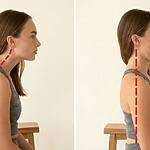
You rarely notice how much you are shrinking into your shoulders until you catch a surprising reflection of yourself in a store window. Fixing that slump does not require a rigid back brace or an hour of Pilates every day. It just takes a few targeted minutes of sending your body a different physical signal.
Why We Slump (and Why We Can’t Just “Stand Up Straight”)
When I was navigating a long stretch of chronic fatigue a few years ago, my body’s default state was a quiet collapse. My shoulders rolled forward almost protectively, trying to conserve whatever little energy I had left. As I slowly regained my footing, I realized my posture had frozen in that tired position.
If you have ever tried to just force your shoulders back and hold them there, you know it works for about three minutes before you forget and slump again. There is a simple mechanical reason for this. When we spend our days leaning over keyboards, steering wheels, and kitchen counters, the muscles in our chest get incredibly tight, while the muscles in our upper back get stretched out and weak.
You cannot fight tight chest muscles with sheer willpower. To actually achieve a straighter back, you have to invite the chest to open up, and then wake up the back muscles so they can do their job of holding you upright. That is exactly what this short daily sequence does.
The 10-Minute Posture Routine
I usually run through these exercises right after I let my dog Barnaby out into the yard in the morning, while the coffee is still brewing. You don’t need to change into workout clothes or roll out a heavy mat. You just need a wall, a doorway, and a little bit of floor space.
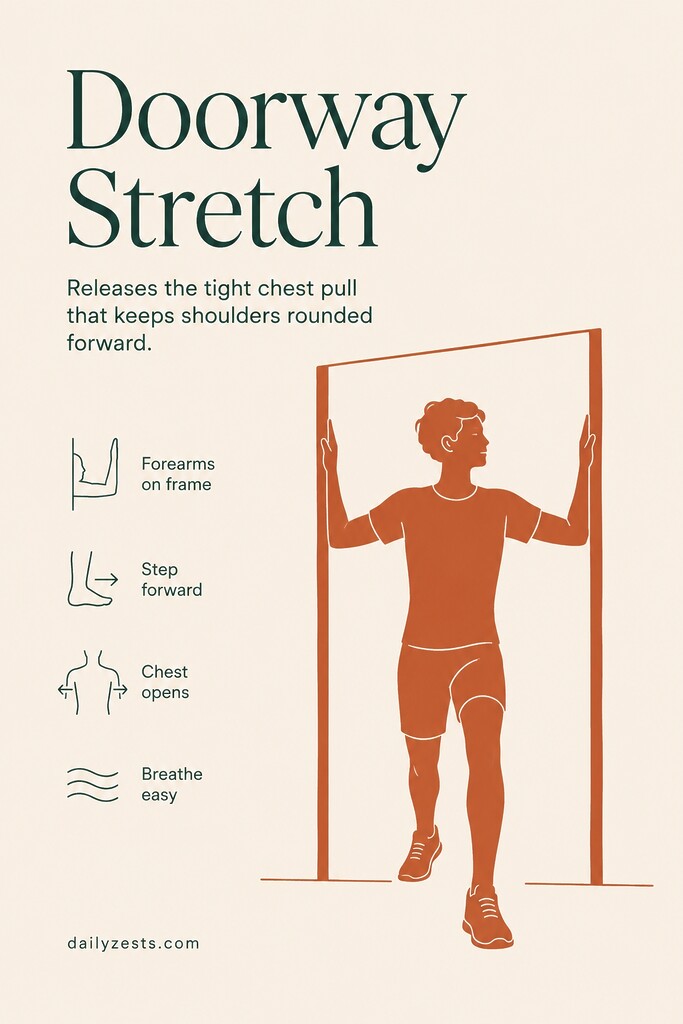
1. The Doorway Stretch (2 Minutes)
We start by releasing the tension pulling you forward. Find any standard doorway in your home.
Place your forearms on the doorframe with your elbows bent at a 90-degree angle, roughly at shoulder height. Slowly step one foot forward through the doorway until you feel a pull across your chest and the front of your shoulders. Do not push until it hurts. Find a spot where it feels like a deep, satisfying release, and breathe naturally.
Hold this for 30 seconds, step back, drop your arms, and rest for a moment. Repeat this three times. You might notice that by the third round, you can step just a tiny bit further forward.
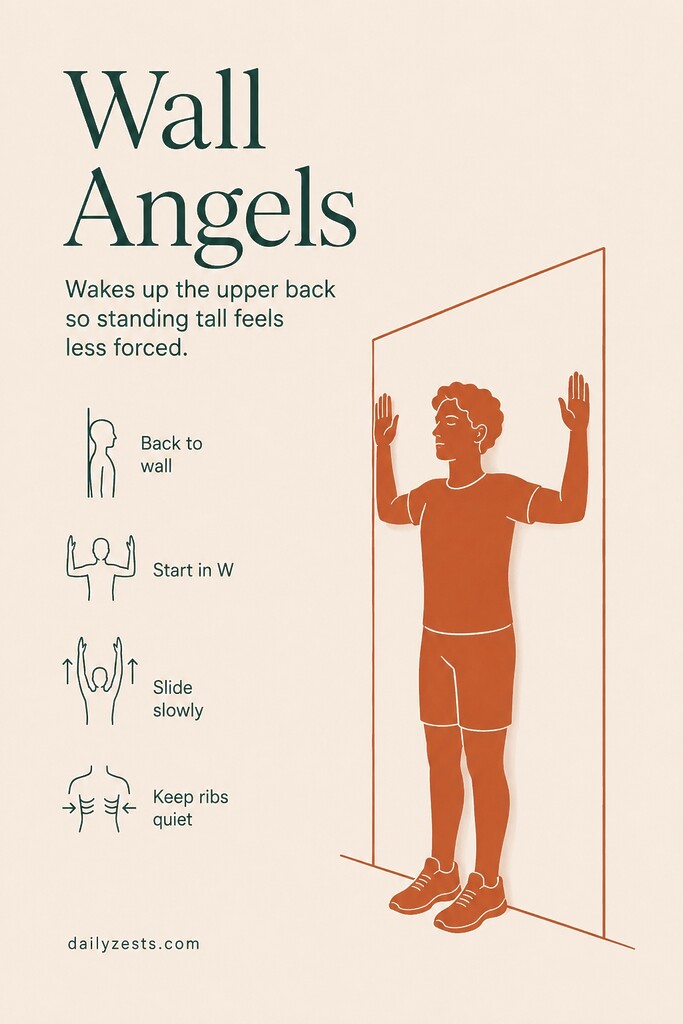
2. Wall Angels (3 Minutes)
Now that the chest is open, we need to activate the upper back. This is often the most frustrating movement for beginners, so give yourself some grace if it feels awkward.
Stand with your back, head, and hips flat against a wall. Bring your arms up into a “W” shape, trying to keep your elbows and the backs of your hands touching the drywall. Slowly slide your arms up the wall toward the ceiling, then pull them back down to the starting position.
If you cannot keep your arms flat against the wall while moving, that is completely normal. Just step your feet a few inches away from the baseboard. That small adjustment changes the angle and makes it much easier to keep your upper body flat. Do two sets of 10 slow repetitions.
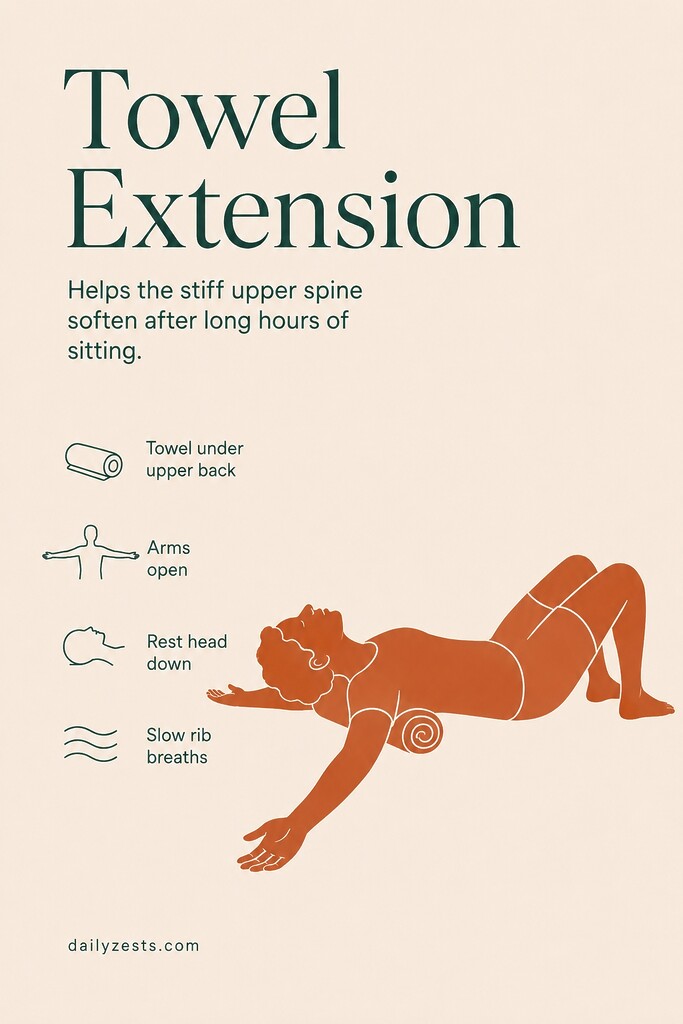
3. Thoracic Extension Over a Towel (2 Minutes)
Your thoracic spine is the middle and upper part of your back. When it gets stiff from sitting, your whole posture suffers. Grab a standard bath towel and roll it into a tight cylinder.
Lie on the floor and place the rolled towel horizontally under your upper back, right around the line of your shoulder blades. Rest your head on the floor, open your arms out to the sides like a letter “T,” and let gravity do the work. You do not have to move or push at all.
Just lie there and breathe deeply into your ribs for two full minutes. It feels surprisingly restorative, especially at the end of a long workday.
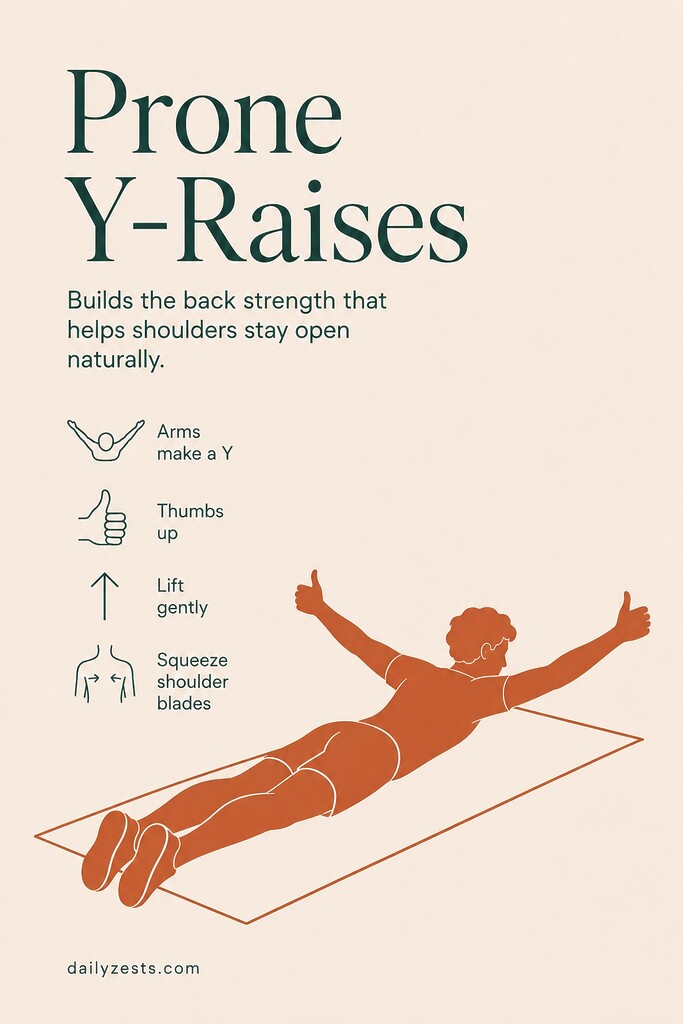
Lie face down on the floor. Extend your arms up and out, forming a “Y” shape with your body. Point your thumbs toward the ceiling. Squeeze your shoulder blades together and lift your arms and chest a few inches off the floor. Hold for two seconds at the top, then slowly lower back down.
Focus on using your back muscles to lift, rather than jerking your neck up. Aim for two sets of 10 repetitions. If you find your lower back doing all the work, squeeze your glutes lightly to stabilize your pelvis.
The Adjustment Period
A quick heads-up: when you stand up after doing this routine, you are probably going to feel like you are sticking your chest out unnaturally far. You aren’t. Your brain has simply adapted to your slumped posture as the “normal” baseline, so standing properly suddenly feels exaggerated.
Check your profile in a mirror if you don’t believe it. You are just standing tall.
Do this routine daily for two weeks. It doesn’t matter if you do it first thing in the morning or right before bed. Just give your body those ten minutes of opposing movement, and notice how much lighter your shoulders feel when you finally stop carrying them forward.
Kristina Hanson is an independent wellness researcher and the founder of DailyZests. She specializes in translating nutritional science into simple, delicious recipes that fit into real life. When she isn’t in the kitchen, you’ll find her hiking the trails or enjoying a slow morning coffee with her Golden Retriever, Barnaby. Read her full story.


 This post may contain affiliate links.