For years, I woke up feeling just as drained as when my head hit the pillow. I assumed fixing my chronic fatigue meant adopting a rigid, two-hour nighttime protocol that I would inevitably fail to follow. Thankfully, building better sleep habits does not require turning your evenings into a strict chore.
The internet is full of intense sleep hygiene tips. You will see advice telling you to buy expensive supplements, invest in soundproof curtains, and follow a ten-step skincare routine by candlelight. If you enjoy those things, they are wonderful. But if you just want to feel rested tomorrow morning, you only need to send your body a few clear signals that it is time to power down.
I realized that fighting my natural rhythm was part of the problem. Instead of forcing sleep, I started inviting it in. Here are three reliable ways to do exactly that.
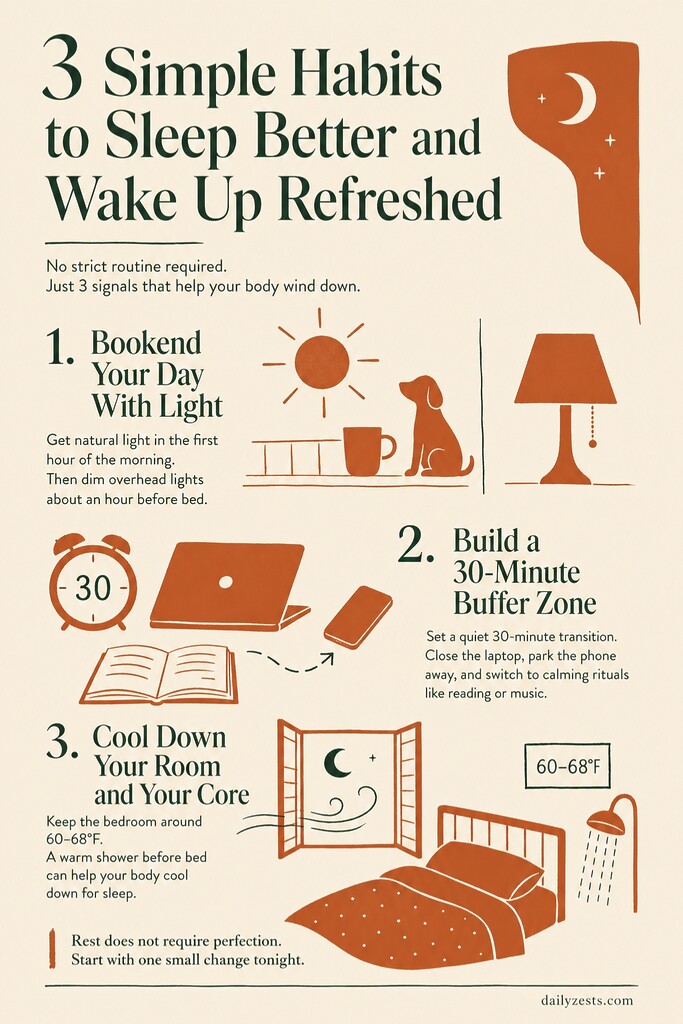
1. Bookend Your Day With Light
We often think about sleep as something that only happens at night. Research suggests our internal clocks are actually set by what we do in the first hour of the morning. Exposing your eyes to natural sunlight early in the day signals your brain to halt melatonin production and wake you up.
This is why taking my dog Barnaby out for a slow morning coffee on the porch is not just a nice ritual for me. It serves a biological purpose. Getting outside for even ten minutes tells your body the day has begun, which means your body will know exactly when the day should end.
At night, you want to reverse this process. About an hour before you intend to sleep, turn off the bright overhead lights in your home. Switch to small table lamps. Lowering the light in your physical space mimics the setting sun, gently nudging your brain into its natural wind-down phase.
2. Build a 30-Minute Buffer Zone
You might be thinking you do not have the time or energy for a long, spa-like evening. You absolutely do not need one. What you do need is a brief transition period.
Many of us work, scroll, or clean right up until the minute we climb under the covers, and then we wonder why our minds are still racing. A healthy bedtime routine requires a buffer zone between doing and resting. Set a quiet alarm for 30 minutes before you want to be asleep. When it goes off, close the laptop. Put the phone on the charger in another room if you can.
Use this half hour for things that do not demand anything from you. Wash your face, read a few pages of a physical book, or listen to quiet music. You are simply showing your brain that the productive part of the day is officially over.
3. Cool Down Your Room and Your Core
Your body temperature naturally drops as you prepare for sleep. If your bedroom is too warm, your body has to fight to achieve that necessary cooling phase, which often leads to tossing, turning, and waking up covered in sweat.
Most experts suggest keeping your bedroom between 60°F and 68°F for optimal rest. You can support this cooling process by taking a warm shower or bath about an hour before bed. It sounds completely backward, but stepping out of warm water into a cool room causes your core body temperature to drop rapidly. This drop acts as a powerful biological trigger that tells your system it is time to sleep.
If you cannot control your thermostat, focus on your bedding. Swap heavy synthetic comforters for breathable cotton or linen layers that you can easily push aside in the middle of the night.
Rest Does Not Require Perfection
The pressure to sleep perfectly is often what keeps us awake. If you stay up late one night, or forget to dim the lights, your body will recover. You do not have to tackle all of these steps at once.
Pick one small change to try tonight. Turn on a lamp instead of the ceiling light, or set a timer for a 30-minute buffer. Real rest begins the moment you stop fighting your body and start listening to it instead.
Kristina Hanson is an independent wellness researcher and the founder of DailyZests. She specializes in translating nutritional science into simple, delicious recipes that fit into real life. When she isn’t in the kitchen, you’ll find her hiking the trails or enjoying a slow morning coffee with her Golden Retriever, Barnaby. Read her full story.



 This post may contain affiliate links.