Being diagnosed with PCOS often feels like being handed a massive list of restrictions. You are told what not to eat, what not to do, and how hard you need to fight your own hormones. Having a reliable PCOS self care checklist changes that dynamic entirely. It gives you a clear baseline for your day without requiring perfection.
I spent my late twenties trying to force my body into submission with rigid routines. Actually, “rigid” does not quite cover it. They were punishing. I counted every calorie, pushed through exhausting workouts, and spent most afternoons fighting a hollow, shaky fatigue that always seemed to hit at exactly 3 PM. My body was sending me clear signals, and I was entirely ignoring them.
Everything shifted when I stopped fighting my biology and started understanding it. Polycystic Ovary Syndrome is incredibly sensitive to our environment, our stress levels, and our daily rhythms. We do not need a boot camp. We need consistency.
I know a checklist sounds like just another set of demands when you are already running on empty. I completely understand that hesitation. But these are not strict demands. These are easygoing invitations to help your body feel safer and more balanced throughout the day.
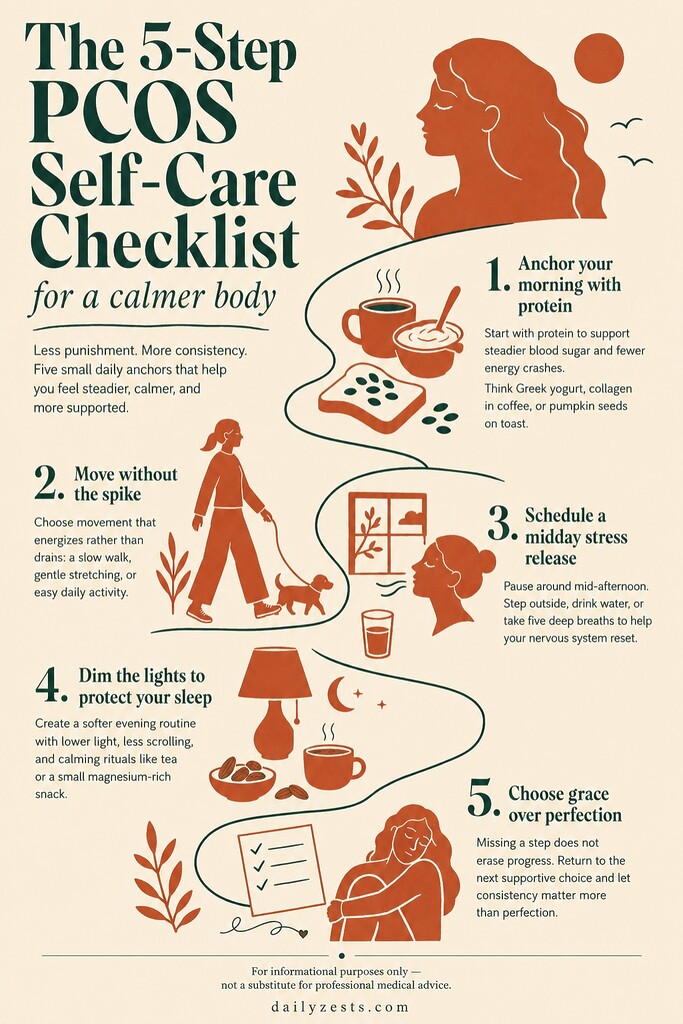
The 5-Step PCOS Daily Routine
You do not have to tackle all of these tomorrow. Pick one that sounds appealing, try it for a week, and see how your energy responds.
1. Anchor your morning with protein
How you start your morning dictates how your hormones behave for the rest of the day. A breakfast made mostly of carbohydrates sets you up for a steep climb and a sharp fall.
When you eat carbohydrates on their own, your body releases a surge of insulin to process them. For those of us with PCOS, our cells often resist that insulin. The glucose stays in our bloodstream longer, which leaves us feeling tired, foggy, and hungry an hour later. Protein acts like a buffer. It slows down digestion and gives your blood sugar a slow, steady rise instead of a spike.
You do not need to make a complicated meal. Try stirring collagen powder into your morning coffee, eating a cup of Greek yogurt, or keeping a jar of roasted pumpkin seeds on the counter so you can toss them onto a piece of toast. Small changes here make a profound difference.
2. Move without the spike
One thing that can backfire for PCOS is forcing your body through a grueling workout when your stress hormones are already high. I used to think I had to sweat heavily for an exercise to count. That mindset left me constantly inflamed and holding onto unexplained weight.
For PCOS, research on regular movement suggests that it is incredibly supportive of hormone health. It helps your muscles use glucose for energy without demanding the same stress response as an all-out workout. For me, that looks like a slow 20-minute walk around the neighborhood with my Golden Retriever, Barnaby. Some days it is just stretching on the living room rug. Find movement that leaves you feeling energized, not depleted.
3. Schedule a midday stress release
PCOS can be closely tied to stress signaling and adrenal hormones. If you are rushing from task to task, your body believes it is in danger. You have to actively signal to your nervous system that you are safe.
Around 2 PM, step away from your screens. Go outside and feel the air, drink a large glass of water, or just sit with your eyes closed and take five deep breaths. It sounds almost too simple to matter. But giving your nervous system a chance to reset prevents that late-afternoon hormone crash.
4. Dim the lights to protect your sleep
Sleep is when your body calibrates insulin and repairs cellular damage. Unfortunately, poor sleep is incredibly common for women dealing with hormone imbalances. Staring at the ceiling at 2 AM with a racing heart can be one sign that your stress response is switched on at the wrong time.
Start your wind-down routine an hour before bed. Turn off the bright overhead lights and switch to warm table lamps. Stop scrolling through social media. Many find that a cup of chamomile tea or a small, magnesium-rich snack like a handful of almonds helps transition the body into rest mode.
5. Choose grace over perfection
This is arguably the most important of all the PCOS self care tips. Stressing over whether you did everything right on this list completely ruins the point. Some days you will eat the sugary pastry for breakfast and skip your walk. That is totally fine.
Your body is incredibly resilient. It just needs a steady, reliable foundation to return to. When you slip off your routine, do not punish yourself. Just drink some water and move on to the next choice.
A quick note: I share what has worked for me and what I have learned through my own research, but I am not a doctor. Always check with your healthcare provider before changing your routine, especially if you are taking medication.
Tomorrow is just another day to try again. Start with breakfast.
Kristina Hanson is an independent wellness researcher and the founder of DailyZests. She specializes in translating nutritional science into simple, delicious recipes that fit into real life. When she isn’t in the kitchen, you’ll find her hiking the trails or enjoying a slow morning coffee with her Golden Retriever, Barnaby. Read her full story.



 This post may contain affiliate links.