Watching someone you care about manage a chronic condition leaves you feeling uniquely unequipped. The natural instinct is to step in and manage it for them. You start scrutinizing grocery receipts. You start questioning their lunch choices. But supporting a partner, parent, or friend with diabetes requires a much lighter touch.
It is entirely possible to help them build healthier routines without turning your kitchen into a battleground.
There is a specific tone of voice people use when they ask, “Are you sure you should be eating that?”
Actually, I should be fair here. That question usually stems from genuine anxiety about your loved one’s future, not a conscious desire to control them. But the result is identical. It immediately places you in a parental role and leaves them feeling scrutinized. Over time, this dynamic just encourages them to hide their snacks in the car and builds quiet resentment in the house.
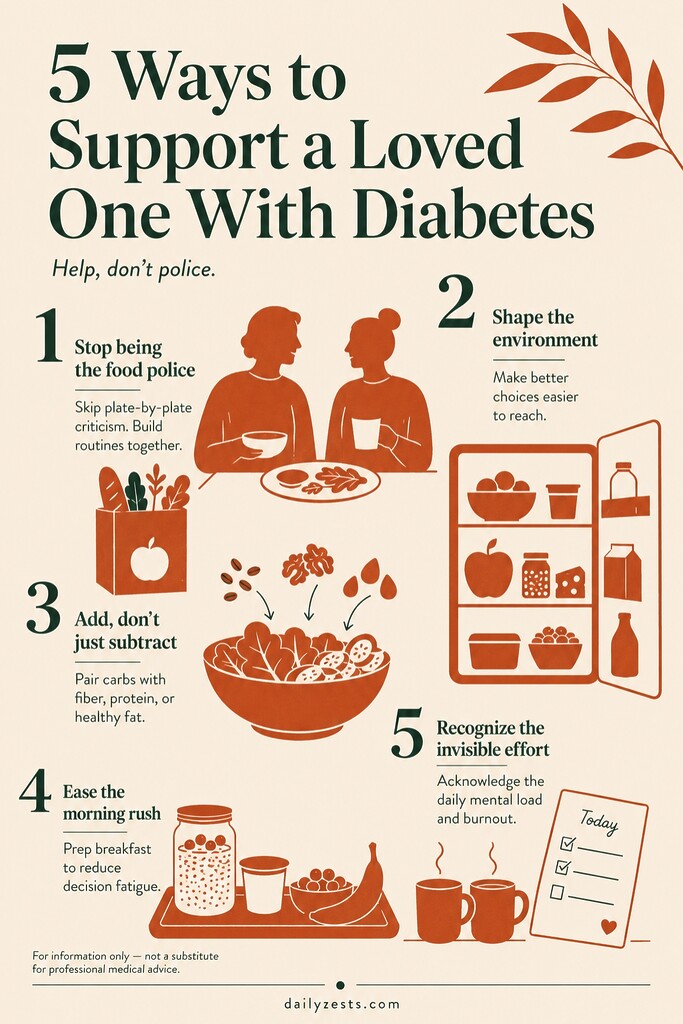
The most helpful thing you can do is let go of micromanaging single meals. If you want to help with their diet, focus on the baseline. Cook dinner together. Ask if they want company on a grocery run. Shift your energy away from critiquing their plate and toward participating in the broader household routine.
2. Let your shared environment do the heavy lifting
Willpower is a deeply unreliable resource, especially at the end of a long workday. When I was first trying to untangle my own insulin resistance, the daily 3 PM blood sugar crash felt completely insurmountable. If a box of graham crackers was sitting on the counter, I ate it. It was that simple.
You can offer massive support just by altering the geography of your kitchen. Make the choices they want to make the easiest ones to reach. Move the roasted almonds, cheese sticks, and crisp apples to the most visible eye-level shelf in the fridge. Tuck the simple carbohydrates and heavily processed snacks out of direct sight in a lower drawer or opaque pantry bin.
You are not hiding food like a warden. You are just removing the visual friction so their tired brain does not have to make a difficult choice every time they walk into the kitchen for a glass of water.
3. Focus on adding to the plate, rather than subtracting
Dietary changes often feel like a massive list of punishments and restrictions. You can flip this script by focusing on what you can add to their meals to support their goals.
Research suggests that pairing a carbohydrate with fiber, protein, or healthy fat can blunt the immediate glucose rise, especially when those foods come before or alongside the carbohydrate. This means you do not always have to banish their favorite foods entirely. If they are making a bowl of oatmeal, quietly hand them a jar of chia seeds or walnuts to stir in. If you are serving pasta, start the meal with a large, fiber-heavy salad. Adding these buffers helps maintain steadier energy levels throughout the afternoon.
4. Take over the morning decision fatigue
Mornings are notoriously difficult for metabolic health. Cortisol levels are naturally higher, time is tight, and breakfast often devolves into whatever can be eaten standing up near the sink. This is a highly practical place for a supporter to step in.
If you have the time, taking over the morning food prep removes a huge mental hurdle for your partner. You do not need to cook a diner-style feast. Just having something ready that aligns with their needs sets the tone for their entire day.
5. Acknowledge the quiet math they are always doing
People living with diabetes are essentially acting as a manual pancreas. There is a constant, invisible hum of calculations running in the background of their day. You can often see it in the brief, heavy sigh they let out while scanning a restaurant menu, doing the mental math of carbohydrates, insulin timing, or medication schedules.
It is utterly exhausting.
Diabetes burnout is a very real phenomenon where the daily weight of the condition simply becomes too much. Sometimes, the best support you can offer has nothing to do with food. It is simply acknowledging the effort they put in every single day. Let them vent when their numbers act completely irrational despite them doing everything right. Remind them that a single high reading is just data, not a moral failure.
As a reminder, I am a researcher sharing lifestyle habits, not a doctor. Always encourage your loved one to lean on their primary care team when adjusting their medical routine.
At the end of the day, they are the ones carrying the condition. Your job is just to clear the road a little bit so they do not have to walk it entirely alone.
Kristina Hanson is an independent wellness researcher and the founder of DailyZests. She specializes in translating nutritional science into simple, delicious recipes that fit into real life. When she isn’t in the kitchen, you’ll find her hiking the trails or enjoying a slow morning coffee with her Golden Retriever, Barnaby. Read her full story.
This article is a great starting point, but I’m a bit confused about the whole ‘become a diabetes detective’ thing. Does that mean I need to start carrying a magnifying glass and a notepad everywhere? Seriously though, I want to be supportive, but I also don’t want to become the ‘diabetes police.’ My husband was recently diagnosed, and he’s already feeling overwhelmed. How do I find that balance between being helpful and being, well, a nag?
Hi Jennifer, thanks for the comment! Haha, no magnifying glass required! ‘Diabetes detective’ is more about educating yourself so you can have informed conversations with your husband. It’s about understanding the ‘why’ behind the choices he needs to make. Think of it as becoming a knowledgeable ally rather than a police officer.
The key is to approach it with empathy and collaboration. Instead of saying ‘You shouldn’t eat that,’ try ‘Hey, I read that [food] can spike blood sugar. Maybe we can find a healthier alternative together?’ Also, the section ‘Champion Their Health: Encouraging Positive Lifestyle Choices’ has some great tips on this. It’s about teamwork and making healthy choices enjoyable, not a chore. Also, directly asking your husband, ‘How can I best support you?’ can open up a valuable conversation. You’ve got this, Jennifer!
My sister has Type 1 diabetes, and she’s always on her phone checking something. It drives me nuts! This article mentions CGMs and apps. Are these things really necessary? It seems like technology is taking over our lives. Plus, she gets really sensitive about me asking about her blood sugar. How do I show her that I care without seeming like I’m invading her privacy?
Hi Patricia, I understand your concern. Technology can feel overwhelming, but in the case of diabetes management, it can be a real game-changer. Those CGMs and apps are like having a personal assistant for diabetes! They help track blood sugar levels in real-time, which is crucial for managing Type 1.
Think of it this way: instead of constantly asking ‘What’s your blood sugar?’, which can feel intrusive, the technology provides that information discreetly. It empowers your sister to manage her condition more independently. The section ‘Integrating Technology: A Modern Approach to Diabetes Management’ explains this in more detail.
As for showing you care, maybe you can ask her to explain how the technology works. This shows interest without judgment. You could say something like, ‘Hey, I’ve heard about these CGM things. Can you tell me a bit about how it helps you?’ This opens the door for conversation and shows you’re interested in understanding her experience. It’s all about finding that balance between respecting her privacy and showing your support.
This is such a great article! My mom was recently diagnosed with Type 2 diabetes, and I’ve been feeling so lost on how to help. I really like the idea of becoming an “exercise buddy,” but she’s not exactly a gym rat. Any suggestions for activities that are fun and not too intense? Also, the whole “hypoglycemia hero” thing is a bit intimidating. How do I know if it’s really an emergency or just a minor dip?
Léa, you’re a great daughter for wanting to support your mom! For exercise, think outside the gym! How about dancing, gardening, or even just walking around the neighborhood and window shopping? The key is to find something she enjoys. As for hypoglycemia, it’s always better to err on the side of caution. If she’s confused, very shaky, or acting really out of character, treat it as serious. Always have those fast-acting glucose tabs or a sugary drink on hand, and don’t hesitate to call for help if things don’t improve quickly. You got this!
My partner has Type 1 diabetes, and sometimes I feel like I’m walking on eggshells. I don’t want to be the “diabetes police,” but I also worry about him. The article mentions cooking together, but honestly, I’m a terrible cook! Any suggestions for super easy, diabetes-friendly meals? Also, is it okay to ask about his blood sugar readings, or is that too intrusive? I just want to make sure that he will be fine!
Riley, I hear you! It’s a tough balance between being supportive and overbearing. Don’t worry about being a master chef! There are tons of simple, healthy recipes online. Think sheet pan dinners (veggies and protein roasted on one pan), or big salads with grilled chicken or fish. As for asking about blood sugar, communication is key! Maybe say something like, “Hey, is there anything I can do to help you manage your blood sugar today?” It shows you care without being controlling. You’re doing great!






 This post may contain affiliate links.









This article is a great starting point, but I’m a bit confused about the whole ‘become a diabetes detective’ thing. Does that mean I need to start carrying a magnifying glass and a notepad everywhere? Seriously though, I want to be supportive, but I also don’t want to become the ‘diabetes police.’ My husband was recently diagnosed, and he’s already feeling overwhelmed. How do I find that balance between being helpful and being, well, a nag?
Hi Jennifer, thanks for the comment! Haha, no magnifying glass required! ‘Diabetes detective’ is more about educating yourself so you can have informed conversations with your husband. It’s about understanding the ‘why’ behind the choices he needs to make. Think of it as becoming a knowledgeable ally rather than a police officer.
The key is to approach it with empathy and collaboration. Instead of saying ‘You shouldn’t eat that,’ try ‘Hey, I read that [food] can spike blood sugar. Maybe we can find a healthier alternative together?’ Also, the section ‘Champion Their Health: Encouraging Positive Lifestyle Choices’ has some great tips on this. It’s about teamwork and making healthy choices enjoyable, not a chore. Also, directly asking your husband, ‘How can I best support you?’ can open up a valuable conversation. You’ve got this, Jennifer!
My sister has Type 1 diabetes, and she’s always on her phone checking something. It drives me nuts! This article mentions CGMs and apps. Are these things really necessary? It seems like technology is taking over our lives. Plus, she gets really sensitive about me asking about her blood sugar. How do I show her that I care without seeming like I’m invading her privacy?
Hi Patricia, I understand your concern. Technology can feel overwhelming, but in the case of diabetes management, it can be a real game-changer. Those CGMs and apps are like having a personal assistant for diabetes! They help track blood sugar levels in real-time, which is crucial for managing Type 1.
Think of it this way: instead of constantly asking ‘What’s your blood sugar?’, which can feel intrusive, the technology provides that information discreetly. It empowers your sister to manage her condition more independently. The section ‘Integrating Technology: A Modern Approach to Diabetes Management’ explains this in more detail.
As for showing you care, maybe you can ask her to explain how the technology works. This shows interest without judgment. You could say something like, ‘Hey, I’ve heard about these CGM things. Can you tell me a bit about how it helps you?’ This opens the door for conversation and shows you’re interested in understanding her experience. It’s all about finding that balance between respecting her privacy and showing your support.
This is such a great article! My mom was recently diagnosed with Type 2 diabetes, and I’ve been feeling so lost on how to help. I really like the idea of becoming an “exercise buddy,” but she’s not exactly a gym rat. Any suggestions for activities that are fun and not too intense? Also, the whole “hypoglycemia hero” thing is a bit intimidating. How do I know if it’s really an emergency or just a minor dip?
Léa, you’re a great daughter for wanting to support your mom! For exercise, think outside the gym! How about dancing, gardening, or even just walking around the neighborhood and window shopping? The key is to find something she enjoys. As for hypoglycemia, it’s always better to err on the side of caution. If she’s confused, very shaky, or acting really out of character, treat it as serious. Always have those fast-acting glucose tabs or a sugary drink on hand, and don’t hesitate to call for help if things don’t improve quickly. You got this!
My partner has Type 1 diabetes, and sometimes I feel like I’m walking on eggshells. I don’t want to be the “diabetes police,” but I also worry about him. The article mentions cooking together, but honestly, I’m a terrible cook! Any suggestions for super easy, diabetes-friendly meals? Also, is it okay to ask about his blood sugar readings, or is that too intrusive? I just want to make sure that he will be fine!
Riley, I hear you! It’s a tough balance between being supportive and overbearing. Don’t worry about being a master chef! There are tons of simple, healthy recipes online. Think sheet pan dinners (veggies and protein roasted on one pan), or big salads with grilled chicken or fish. As for asking about blood sugar, communication is key! Maybe say something like, “Hey, is there anything I can do to help you manage your blood sugar today?” It shows you care without being controlling. You’re doing great!