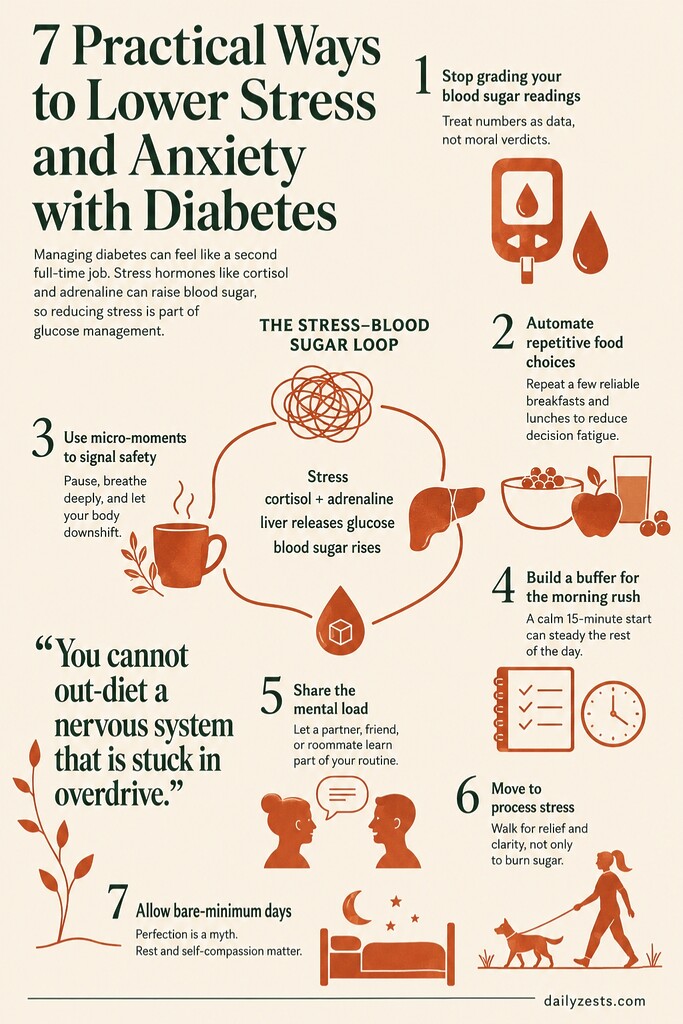
Managing blood sugar often feels like a second full-time job, one you never applied for and can never clock out of. Between the constant carb counting, the monitor alarms, and the sheer volume of daily decisions, it is completely understandable if you occasionally hit a wall of pure exhaustion.
When a doctor tells you to “manage your stress,” it usually feels incredibly frustrating. After all, trying to keep yourself healthy is often the exact thing causing the anxiety in the first place.
When I was dealing with my own severe insulin resistance and fighting brutal 3 PM blood sugar crashes every single afternoon, I realized something important. I could eat exactly according to plan, but if I was running on anxiety and poor sleep, my blood sugar would act like I had just eaten a plate of pastries.
There is a biological reason for this. When we experience stress, our bodies release cortisol and adrenaline. These hormones signal the liver to release stored glucose to give you quick energy to fight or flee. But if you have insulin resistance or diabetes, that extra glucose simply gets stuck in your bloodstream.
You cannot out-diet a nervous system that is stuck in overdrive.
A quick note before we get into the tips: I am sharing what I have learned as an independent researcher and what worked for my own metabolic health. This is not medical advice, so please keep your healthcare team in the loop before making any major changes to your routine.
7 Tips for Managing Diabetes Anxiety Without Adding to Your To-Do List
1. Stop grading your blood sugar readings.
A high number is not a failure, and a low number is not a punishment. One of the strongest choices you can make for your mental health is to strip the morality away from your glucose meter.
Think of it purely as data. A spike simply means your body is asking for an adjustment. It is a piece of information, not a report card on your willpower or worth.
2. Automate your most repetitive food choices.
Decision fatigue is a massive trigger for daily anxiety. If you have to negotiate with yourself three times a day about what to eat to keep your numbers stable, you will inevitably burn out.
Remove the guesswork where you can. Pick two breakfasts and three lunches that you know work well for your body, and rotate them. Save your mental energy for dinners or weekend meals where you might want a little more variety.
3. Use micro-moments to signal safety to your nervous system.
You do not need to book a weekend retreat or meditate for an hour a day to lower your cortisol. Actually, setting unrealistic relaxation goals usually just creates more pressure.
When your continuous glucose monitor goes off and you feel the panic rising in your chest, pause. Taking a few minutes to breathe deeply can help dial down your body’s stress response. It tells your brain that you are not in immediate physical danger, which may help reduce the hormonal push behind extra glucose release from your liver.
4. Build a buffer for the morning rush.
Mornings are notoriously difficult for metabolic health. Between the dawn phenomenon (where your body naturally releases hormones that raise glucose to wake you up) and the rush of getting out the door, your morning numbers can be highly volatile.
Waking up just fifteen minutes earlier to sit quietly with a glass of water can change the entire trajectory of your day. A calm morning keeps your adrenaline in check, which often translates to more predictable blood sugar before lunch.
5. Share the mental load with your circle.
Managing this condition can feel incredibly isolating because you are constantly doing invisible math that nobody else sees. You are calculating carbs, predicting insulin needs, and adjusting for activity levels, all while trying to hold a normal conversation.
Explain a small piece of your routine to a partner, a roommate, or a close friend. Let them learn what your low symptoms look like, or show them exactly where you keep your emergency snacks in the kitchen. You do not have to carry the whole bag completely alone.
6. Move your body to process stress, not just to burn sugar.
We hear constantly that exercise is great for blood sugar control. But if you view a walk only as a mechanical tool to bring down a glucose spike, movement becomes just another medical chore.
Try leaving the fitness tracker at home once in a while. Take the dog for an unhurried walk around the neighborhood. My Golden Retriever, Barnaby, is excellent at reminding me to stop and look at the trees instead of my watch. Let the movement be about clearing your head and feeling good in your body.
7. Allow yourself days where you just do the bare minimum.
Perfect management is a myth. Some days, you will eat a little off-plan. You might forget to log your numbers, or skip your workout because you are simply too tired.
That is entirely okay. Living in a state of chronic, rigid perfectionism does more long-term damage to your nervous system than a single imperfect day of eating. Give yourself the grace to rest when you need it. Your health is built on what you do most of the time, not what you do on your most exhausted days.
Kristina Hanson is an independent wellness researcher and the founder of DailyZests. She specializes in translating nutritional science into simple, delicious recipes that fit into real life. When she isn’t in the kitchen, you’ll find her hiking the trails or enjoying a slow morning coffee with her Golden Retriever, Barnaby. Read her full story.






 This post may contain affiliate links.