If there is one word that makes anyone managing blood sugar freeze, it is carbohydrates. But managing diabetes doesn’t mean banishing your favorite foods from the kitchen forever. It just means learning how to make them work with your body instead of against it.
For years, my days were ruled by the 3 PM crash. I would hit a wall of fatigue so thick I could barely keep my eyes open, followed by an intense craving for anything sweet. It can happen when blood sugar is running high, though I didn’t know then that insulin resistance can be quiet for years. My blood sugar was soaring after meals and then crashing hard, leaving me exhausted.
I thought the only answer was to cut out carbohydrates entirely. I was wrong. Fighting your body rarely works long-term. Understanding it changes everything.
A quick note from me: I am a researcher and writer sharing what I have learned through my own metabolic health journey. I’m not a doctor, and this isn’t medical advice, just practical, science-backed guidance to help you make informed choices with your healthcare team.
How Blood Sugar Works
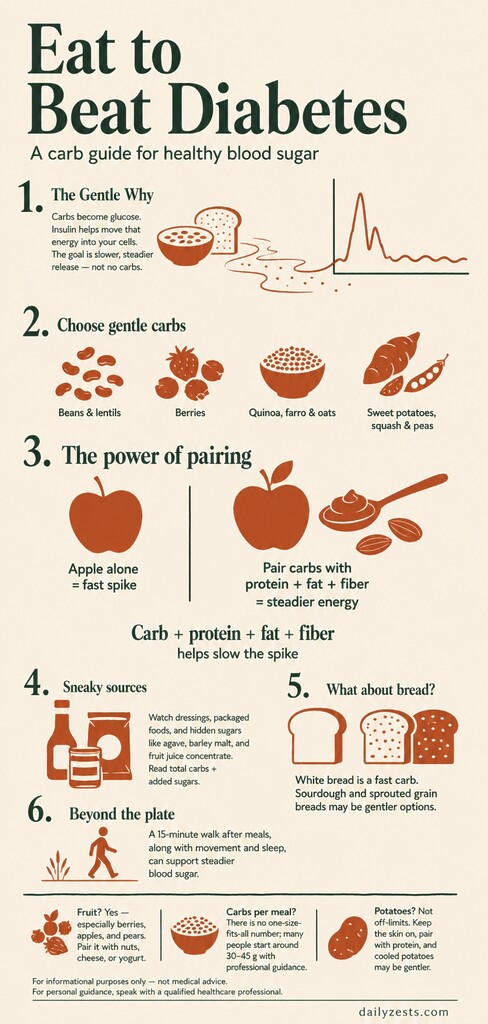
To make peace with carbs, we first have to understand what they do. When we eat carbohydrates, whether it is a slice of cake or a bowl of steel-cut oats, our digestive system breaks them down into glucose. Glucose is just energy. It enters your bloodstream, and a hormone called insulin helps move that energy into your cells so you can use it.
If you have diabetes or insulin resistance, this system is a bit rusty. The glucose builds up in the blood because the cells aren’t letting it in efficiently. The goal of a diabetes-friendly diet isn’t to starve your body of energy. The goal is to give your body that energy at a slow, manageable pace.
If you’re still wrapping your head around the broader picture of what to put on your plate, the guide below is a wonderful place to start.
How to Eat Carbs Without the Spike
You don’t need to eat perfectly. You just need to eat strategically. Here is how you can enjoy carbohydrates while supporting stable, healthy blood sugar levels.
1. Focus on “Slow” Carbohydrates
Not all carbs hit your bloodstream at the same speed. Think of carbohydrates as a fire. “Fast carbs” are like paper: they burn instantly, creating a massive, short-lived flame (a blood sugar spike). “Slow carbs” are like thick logs: they burn slowly and steadily, giving you warmth for hours.
Slow carbs are wrapped in fiber. Research shows why: fiber slows down digestion, which means the glucose trickles into your bloodstream instead of flooding it. Some of the best slow-digesting carbohydrates include:
Beans and lentils: Packed with protein and fiber, making them incredibly blood-sugar friendly.
Berries: Blackberries, raspberries, and strawberries are naturally lower in sugar and very high in fiber.
Whole grains: Quinoa, farro, and rolled oats.
Starchy vegetables: Sweet potatoes, butternut squash, and green peas.
2. The Power of Pairing
This is the single most helpful shift I made for my own energy levels. Never eat a carbohydrate alone. A carb eaten by itself digests quickly. But when you pair that carbohydrate with protein, healthy fat, and fiber, you build a speed bump for your digestion.
If you want an apple, pair it with a handful of almonds or a scoop of peanut butter. Research-informed guidance explains why the fat and protein in the nuts can change how quickly your body absorbs the apple’s natural sugars. If you are having rice with dinner, make sure there is a generous portion of chicken or tofu (protein) and olive oil-roasted broccoli (fiber and fat) right next to it.
3. Watch for the Sneaky Sources
Sometimes the blood sugar spikes come from places we don’t expect. A salad sounds like a perfect lunch until it is drenched in a honey-based vinaigrette. Many packaged foods disguise their sugar content under different names like agave nectar, barley malt, or fruit juice concentrate.
You can find more of these hidden traps in our helpful guide below. Learning to read labels for total carbohydrates and added sugars is a quiet superpower.
What About Bread?
I hear this question more than any other. Bread holds a special place in our hearts and our kitchens. The good news is that you don’t have to give it up.
The trick is choosing the right kind. White bread is a fast carb. It digests almost instantly. Sourdough, on the other hand, undergoes a fermentation process that can alter its starches, and research suggests some versions may be gentler on blood sugar. Sprouted grain breads are also excellent options because the sprouting process increases the availability of nutrients and adds extra fiber.
If you are a sandwich lover, you will want to read the related guide below for a much deeper dive into your bakery aisle options.
Looking Beyond the Plate
What we eat is just one piece of the puzzle. Walking my dog, Barnaby, for just fifteen minutes after a meal does wonders for my own post-meal numbers. Muscles use glucose for energy, so one study helps explain why a light walk actually helps pull that sugar out of your bloodstream and into your muscles where it belongs.
While food is the foundation, movement and sleep play massive roles too. Exploring stable lifestyle choices can help you build a more supportive routine that doesn’t rely entirely on your kitchen.
Once you understand how carbs behave, building a routine is the next hurdle. Setting up a step-by-step plan takes the guesswork out of your week, so you aren’t staring at the fridge at 6 PM wondering what is safe to eat.
Frequently Asked Questions
Can I still eat fruit if I have diabetes?
Yes. Fruit contains natural sugars, but it also contains fiber, vitamins, and minerals. Opt for lower-glycemic fruits like berries, apples, and pears, and remember the golden rule: pair your fruit with a protein or fat, like a handful of walnuts or a slice of cheese.
How many carbs should I eat per meal?
There is no universal number. It depends on your age, activity level, and the specific medications you might be taking. Some registered dietitians use carb-counting guidance with 30 to 45 grams of complex carbohydrates per meal as a starting range, but you should work with your healthcare provider to find the target that keeps your numbers stable.
Are potatoes completely off-limits?
Not at all. While traditional white potatoes digest quickly, you can slow them down by keeping the skin on (extra fiber) and eating them alongside a robust portion of protein. Sweet potatoes are generally a gentler option naturally. Interestingly, cooking and then cooling potatoes creates “resistant starch,” which one study suggests can be gentler on your blood sugar.
Managing your blood sugar takes patience, and there will be days when your numbers do things that don’t make sense. Be gentle with yourself. You are not just managing numbers; you are learning a new language: the language of your own body. And like any language, it gets easier the more you practice.
Kristina Hanson is an independent wellness researcher and the founder of DailyZests. She specializes in translating nutritional science into simple, delicious recipes that fit into real life. When she isn’t in the kitchen, you’ll find her hiking the trails or enjoying a slow morning coffee with her Golden Retriever, Barnaby. Read her full story.
This article is really informative, but I’m a bit overwhelmed by all the information about GI and GL. It seems like a lot to keep track of on top of everything else. Are there any simple rules of thumb I can follow without having to constantly look up the GI and GL of every single food? Also, you mentioned that the average person consumes around 800 calories of carbohydrates daily. Could you please provide some statistics on how this differs between racial groups? I’m curious to see if there are any significant disparities.
Hi Jennifer, thanks for your comment! I understand that GI and GL can seem daunting at first. A good rule of thumb is to focus on whole, unprocessed foods as much as possible. Think vegetables, lean proteins, and healthy fats. When choosing carbs, opt for non-starchy vegetables, berries, and whole grains in moderation. Don’t get too bogged down in the numbers – just aim for a balanced plate with plenty of fiber. Regarding your question about carbohydrate consumption and racial groups, research shows disparities. For instance, data from the CDC’s National Health and Nutrition Examination Survey (NHANES) indicates that non-Hispanic Black adults in the U.S. consume an average of 850 calories from carbohydrates daily, while non-Hispanic white adults consume around 780 calories. Moreover, Hispanic adults consume approximately 820 calories from carbohydrates daily. These differences can be influenced by various cultural and socioeconomic factors. It is important to note that these are averages, and individual intake can vary widely within each group. Also, the American Diabetes Association highlights that diabetes disproportionately affects certain racial and ethnic groups, including Black, Hispanic, American Indian, and Asian American populations. Focusing on culturally relevant dietary education can be beneficial.
I’ve been trying to follow a low-carb diet, but I find it really difficult to stick to, especially when eating out or at social events. It feels very restrictive. Do you have any tips for making it more sustainable in the long run? Also, I’ve heard conflicting information about artificial sweeteners. Are they a good alternative for people with diabetes, or are they harmful?
Hi Sarah, you’re not alone! Many people find low-carb diets challenging to maintain long-term. The key is to find a balance that works for you and doesn’t feel overly restrictive. Instead of completely eliminating carbs, try reducing your intake gradually and focusing on the quality of the carbs you eat. When eating out, look for options that are naturally lower in carbs, like grilled meats or fish with vegetables. Don’t be afraid to ask for modifications, like swapping out fries for a side salad. For social events, offer to bring a healthy dish that you know you can enjoy. As for artificial sweeteners, the research is mixed. Some studies suggest they may have negative effects on gut health and metabolism, while others show no significant harm. The American Diabetes Association considers them safe in moderation, but they are not necessarily beneficial. It is generally best to limit them and focus on whole, unprocessed foods. If you do use them, do so sparingly. Ultimately, it’s about finding a sustainable and enjoyable way of eating that supports your health goals.
Okay, so carbs are like the villains and heroes of the food world, depending on who you ask! This article is helpful in clearing up some of the confusion. I’m especially interested in the Glycemic Index and Load. It sounds like a video game scoring system for food! But seriously, how do you remember which foods are high or low? Is there a cheat sheet or something? I don’t want to carry around a GI encyclopedia in my purse! Also, you mention portion control – does that mean I can still have a small piece of cake on my birthday? Asking the important questions here!
Hi Mary, thanks for your comment! I love the video game analogy – it definitely makes thinking about GI and GL more fun! Remembering all the numbers can be tricky, but you don’t need an encyclopedia. Here are a few tips:
Focus on food groups: Generally, whole, unprocessed foods like non-starchy vegetables, most fruits, and whole grains tend to be lower on the GI scale. Processed foods, sugary drinks, and refined grains are usually higher.
Fiber is your friend: Foods high in fiber tend to have a lower GI because fiber slows down digestion and the absorption of sugar.
Use online resources: There are many websites and apps that provide GI and GL information for various foods. You can easily look up a food if you’re unsure.
And yes, portion control is key! It doesn’t mean you have to completely deprive yourself. A small piece of cake on your birthday is perfectly fine! The key is to be mindful of the portion size and balance it with other healthy choices. Enjoy your cake, but maybe skip the extra sugary toppings or pair it with a protein source to help slow down the sugar absorption. It’s all about balance and moderation!
This article is informative. I’m newly diagnosed with prediabetes, and I’m trying to wrap my head around all the dietary changes. This explanation of how carbs affect blood sugar is really helpful. I’m a big fan of fruit, though, and I’m a little sad to see some of my favorites on the “limit” list. You mention berries being a good choice. Are frozen berries okay, too? Also, about the sample meal plan: it looks pretty healthy, but it seems like it requires a lot of cooking. Are there any quick and easy meal ideas for busy weeknights? I barely have time to breathe, let alone cook elaborate meals!
Hi Patricia, thanks for your comment! It’s understandable to feel overwhelmed when first diagnosed with prediabetes, but you’re taking the right steps by educating yourself. Yes, frozen berries are absolutely fine! They’re just as nutritious as fresh berries and often more convenient. They’re also great for smoothies!
Regarding quick and easy meal ideas, I totally understand the busy weeknight struggle. Here are a few ideas that require minimal cooking:
Salads with pre-cooked protein: Use pre-cooked grilled chicken, canned tuna or salmon, or hard-boiled eggs for a quick and easy protein boost. Add lots of non-starchy vegetables and a healthy dressing (like olive oil and vinegar).
One-pan meals: Roast vegetables and protein (like chicken or tofu) on a single baking sheet for easy cleanup.
Quick stir-fries: Use pre-cut vegetables and a quick stir-fry sauce for a fast and healthy meal.
Soup and salad: Pair a quick and easy soup (like lentil soup or tomato soup) with a simple salad.
Overnight oats: Prepare oatmeal the night before and grab it on your way out the door in the morning.
There are also many healthy meal delivery services or meal prep companies that can help you save time on cooking. Remember, even small changes can make a big difference, so don’t feel like you have to overhaul your entire diet overnight. Start with small, manageable steps, and gradually incorporate more healthy habits into your routine.
This is all very informative, but it feels a little overwhelming. I love my bread, I love my pasta, and I love my occasional sweet treat! The article mentions that the average person consumes about 800 calories of carbs a day. Is that really so bad? And what about different types of people? Do these recommendations apply equally to everyone, regardless of their background or ethnicity? I’ve heard that some cultures traditionally eat more carbs than others. Also, can you share some statistics on how effective these methods are?
Hi Oprah, you bring up some excellent points! It can definitely feel overwhelming to overhaul your diet, and nobody wants to give up all their favorite foods. The 800-calorie figure is an average, and while it might not be “bad” for everyone, it’s significantly higher than what’s generally recommended for someone managing diabetes or prediabetes. Studies have shown that reducing carb intake can be very effective. For example, a meta-analysis published in the journal Nutrients found that low-carb diets significantly improved glycemic control in people with type 2 diabetes. The American Diabetes Association also supports a lower-carb approach as one effective strategy for managing diabetes. For example, research suggests that African Americans may have a higher risk of developing type 2 diabetes, and studies have shown that culturally tailored dietary interventions, which may include modified carb recommendations, can be beneficial. A 2017 study published in the journal Diabetes Care found that African American adults with type 2 diabetes who followed a low-carbohydrate diet experienced significant improvements in blood sugar control and weight loss.
A study published in the journal Ethnicity & Disease highlighted that Asian Americans also have a higher risk, and traditional high-carb diets may play a role. It’s not about eliminating carbs altogether, but rather about being mindful of the quantity and quality. And you’re right to point out cultural differences. Traditional diets vary greatly, and recommendations should be tailored. For example, someone accustomed to a diet rich in rice might focus on portion control and choosing brown rice over white, rather than eliminating rice completely. It’s about finding a balance that respects cultural traditions while supporting health goals. The key is working with a healthcare professional or a registered dietitian to create a personalized plan that fits your individual needs, preferences, and cultural background. And yes, you can still enjoy those occasional treats – just factor them into your overall plan!
Well, bless your heart for trying to make all this carb talk a little easier to swallow! But honey, let’s be real, some of us have a sweet tooth that just won’t quit. Are there any low-carb desserts that actually taste good? Or are we stuck with, as you say, just fruit and yogurt? And what about eating out? Restaurants aren’t always the most accommodating when it comes to special diets. Any tips for navigating a menu when you’re trying to be good?
Hi Dolly, you know I’d never leave you without a sweet treat option! There are actually tons of delicious low-carb dessert recipes out there that use alternative sweeteners and ingredients like almond flour or coconut flour. Think decadent chocolate mousse made with avocado, or cheesecake made with a nut-based crust. You can find amazing recipes online! And as for eating out, it can be tricky, but it’s definitely doable. Most restaurants are getting better at accommodating dietary needs. Don’t be afraid to ask your server about low-carb options or modifications. For example, you can often order a burger without the bun, or ask for extra veggies instead of fries. Salads are usually a good bet, but watch out for sugary dressings – ask for it on the side. And remember, it’s okay to indulge every now and then. Just plan for it, enjoy it, and get back on track with your next meal. Life’s too short to skip all the fun, right?



 This post may contain affiliate links.








This article is really informative, but I’m a bit overwhelmed by all the information about GI and GL. It seems like a lot to keep track of on top of everything else. Are there any simple rules of thumb I can follow without having to constantly look up the GI and GL of every single food? Also, you mentioned that the average person consumes around 800 calories of carbohydrates daily. Could you please provide some statistics on how this differs between racial groups? I’m curious to see if there are any significant disparities.
Hi Jennifer, thanks for your comment! I understand that GI and GL can seem daunting at first. A good rule of thumb is to focus on whole, unprocessed foods as much as possible. Think vegetables, lean proteins, and healthy fats. When choosing carbs, opt for non-starchy vegetables, berries, and whole grains in moderation. Don’t get too bogged down in the numbers – just aim for a balanced plate with plenty of fiber. Regarding your question about carbohydrate consumption and racial groups, research shows disparities. For instance, data from the CDC’s National Health and Nutrition Examination Survey (NHANES) indicates that non-Hispanic Black adults in the U.S. consume an average of 850 calories from carbohydrates daily, while non-Hispanic white adults consume around 780 calories. Moreover, Hispanic adults consume approximately 820 calories from carbohydrates daily. These differences can be influenced by various cultural and socioeconomic factors. It is important to note that these are averages, and individual intake can vary widely within each group. Also, the American Diabetes Association highlights that diabetes disproportionately affects certain racial and ethnic groups, including Black, Hispanic, American Indian, and Asian American populations. Focusing on culturally relevant dietary education can be beneficial.
I’ve been trying to follow a low-carb diet, but I find it really difficult to stick to, especially when eating out or at social events. It feels very restrictive. Do you have any tips for making it more sustainable in the long run? Also, I’ve heard conflicting information about artificial sweeteners. Are they a good alternative for people with diabetes, or are they harmful?
Hi Sarah, you’re not alone! Many people find low-carb diets challenging to maintain long-term. The key is to find a balance that works for you and doesn’t feel overly restrictive. Instead of completely eliminating carbs, try reducing your intake gradually and focusing on the quality of the carbs you eat. When eating out, look for options that are naturally lower in carbs, like grilled meats or fish with vegetables. Don’t be afraid to ask for modifications, like swapping out fries for a side salad. For social events, offer to bring a healthy dish that you know you can enjoy. As for artificial sweeteners, the research is mixed. Some studies suggest they may have negative effects on gut health and metabolism, while others show no significant harm. The American Diabetes Association considers them safe in moderation, but they are not necessarily beneficial. It is generally best to limit them and focus on whole, unprocessed foods. If you do use them, do so sparingly. Ultimately, it’s about finding a sustainable and enjoyable way of eating that supports your health goals.
Okay, so carbs are like the villains and heroes of the food world, depending on who you ask! This article is helpful in clearing up some of the confusion. I’m especially interested in the Glycemic Index and Load. It sounds like a video game scoring system for food! But seriously, how do you remember which foods are high or low? Is there a cheat sheet or something? I don’t want to carry around a GI encyclopedia in my purse! Also, you mention portion control – does that mean I can still have a small piece of cake on my birthday? Asking the important questions here!
Hi Mary, thanks for your comment! I love the video game analogy – it definitely makes thinking about GI and GL more fun! Remembering all the numbers can be tricky, but you don’t need an encyclopedia. Here are a few tips:
Focus on food groups: Generally, whole, unprocessed foods like non-starchy vegetables, most fruits, and whole grains tend to be lower on the GI scale. Processed foods, sugary drinks, and refined grains are usually higher.
Fiber is your friend: Foods high in fiber tend to have a lower GI because fiber slows down digestion and the absorption of sugar.
Use online resources: There are many websites and apps that provide GI and GL information for various foods. You can easily look up a food if you’re unsure.
And yes, portion control is key! It doesn’t mean you have to completely deprive yourself. A small piece of cake on your birthday is perfectly fine! The key is to be mindful of the portion size and balance it with other healthy choices. Enjoy your cake, but maybe skip the extra sugary toppings or pair it with a protein source to help slow down the sugar absorption. It’s all about balance and moderation!
This article is informative. I’m newly diagnosed with prediabetes, and I’m trying to wrap my head around all the dietary changes. This explanation of how carbs affect blood sugar is really helpful. I’m a big fan of fruit, though, and I’m a little sad to see some of my favorites on the “limit” list. You mention berries being a good choice. Are frozen berries okay, too? Also, about the sample meal plan: it looks pretty healthy, but it seems like it requires a lot of cooking. Are there any quick and easy meal ideas for busy weeknights? I barely have time to breathe, let alone cook elaborate meals!
Hi Patricia, thanks for your comment! It’s understandable to feel overwhelmed when first diagnosed with prediabetes, but you’re taking the right steps by educating yourself. Yes, frozen berries are absolutely fine! They’re just as nutritious as fresh berries and often more convenient. They’re also great for smoothies!
Regarding quick and easy meal ideas, I totally understand the busy weeknight struggle. Here are a few ideas that require minimal cooking:
Salads with pre-cooked protein: Use pre-cooked grilled chicken, canned tuna or salmon, or hard-boiled eggs for a quick and easy protein boost. Add lots of non-starchy vegetables and a healthy dressing (like olive oil and vinegar).
One-pan meals: Roast vegetables and protein (like chicken or tofu) on a single baking sheet for easy cleanup.
Quick stir-fries: Use pre-cut vegetables and a quick stir-fry sauce for a fast and healthy meal.
Soup and salad: Pair a quick and easy soup (like lentil soup or tomato soup) with a simple salad.
Overnight oats: Prepare oatmeal the night before and grab it on your way out the door in the morning.
There are also many healthy meal delivery services or meal prep companies that can help you save time on cooking. Remember, even small changes can make a big difference, so don’t feel like you have to overhaul your entire diet overnight. Start with small, manageable steps, and gradually incorporate more healthy habits into your routine.
This is all very informative, but it feels a little overwhelming. I love my bread, I love my pasta, and I love my occasional sweet treat! The article mentions that the average person consumes about 800 calories of carbs a day. Is that really so bad? And what about different types of people? Do these recommendations apply equally to everyone, regardless of their background or ethnicity? I’ve heard that some cultures traditionally eat more carbs than others. Also, can you share some statistics on how effective these methods are?
Hi Oprah, you bring up some excellent points! It can definitely feel overwhelming to overhaul your diet, and nobody wants to give up all their favorite foods. The 800-calorie figure is an average, and while it might not be “bad” for everyone, it’s significantly higher than what’s generally recommended for someone managing diabetes or prediabetes. Studies have shown that reducing carb intake can be very effective. For example, a meta-analysis published in the journal Nutrients found that low-carb diets significantly improved glycemic control in people with type 2 diabetes. The American Diabetes Association also supports a lower-carb approach as one effective strategy for managing diabetes. For example, research suggests that African Americans may have a higher risk of developing type 2 diabetes, and studies have shown that culturally tailored dietary interventions, which may include modified carb recommendations, can be beneficial. A 2017 study published in the journal Diabetes Care found that African American adults with type 2 diabetes who followed a low-carbohydrate diet experienced significant improvements in blood sugar control and weight loss.
A study published in the journal Ethnicity & Disease highlighted that Asian Americans also have a higher risk, and traditional high-carb diets may play a role. It’s not about eliminating carbs altogether, but rather about being mindful of the quantity and quality. And you’re right to point out cultural differences. Traditional diets vary greatly, and recommendations should be tailored. For example, someone accustomed to a diet rich in rice might focus on portion control and choosing brown rice over white, rather than eliminating rice completely. It’s about finding a balance that respects cultural traditions while supporting health goals. The key is working with a healthcare professional or a registered dietitian to create a personalized plan that fits your individual needs, preferences, and cultural background. And yes, you can still enjoy those occasional treats – just factor them into your overall plan!
Well, bless your heart for trying to make all this carb talk a little easier to swallow! But honey, let’s be real, some of us have a sweet tooth that just won’t quit. Are there any low-carb desserts that actually taste good? Or are we stuck with, as you say, just fruit and yogurt? And what about eating out? Restaurants aren’t always the most accommodating when it comes to special diets. Any tips for navigating a menu when you’re trying to be good?
Hi Dolly, you know I’d never leave you without a sweet treat option! There are actually tons of delicious low-carb dessert recipes out there that use alternative sweeteners and ingredients like almond flour or coconut flour. Think decadent chocolate mousse made with avocado, or cheesecake made with a nut-based crust. You can find amazing recipes online! And as for eating out, it can be tricky, but it’s definitely doable. Most restaurants are getting better at accommodating dietary needs. Don’t be afraid to ask your server about low-carb options or modifications. For example, you can often order a burger without the bun, or ask for extra veggies instead of fries. Salads are usually a good bet, but watch out for sugary dressings – ask for it on the side. And remember, it’s okay to indulge every now and then. Just plan for it, enjoy it, and get back on track with your next meal. Life’s too short to skip all the fun, right?