Getting a blood sugar diagnosis usually comes with a long list of things you are not supposed to eat anymore. It is exhausting. But building a diabetic meal plan for beginners does not have to mean eating plain chicken and steamed broccoli for the rest of your life.
I remember the sheer panic of trying to overhaul my entire kitchen after years of dealing with insulin resistance. The 3 PM blood sugar crash hit hard every day, leaving me brain-fogged and reaching for anything in the pantry. When I tried to fix it, I thought I had to throw away every carbohydrate in the house. That lasted exactly three days.
What actually works is much quieter. It is about understanding how food behaves in your body and setting up a routine that supports you.
Before we look at the steps, I want to add a quick note. I am a researcher who figured out what worked for my own insulin resistance, not a doctor. Always check with your care team before making major changes to your diet, especially if you are taking medications that affect your blood sugar.
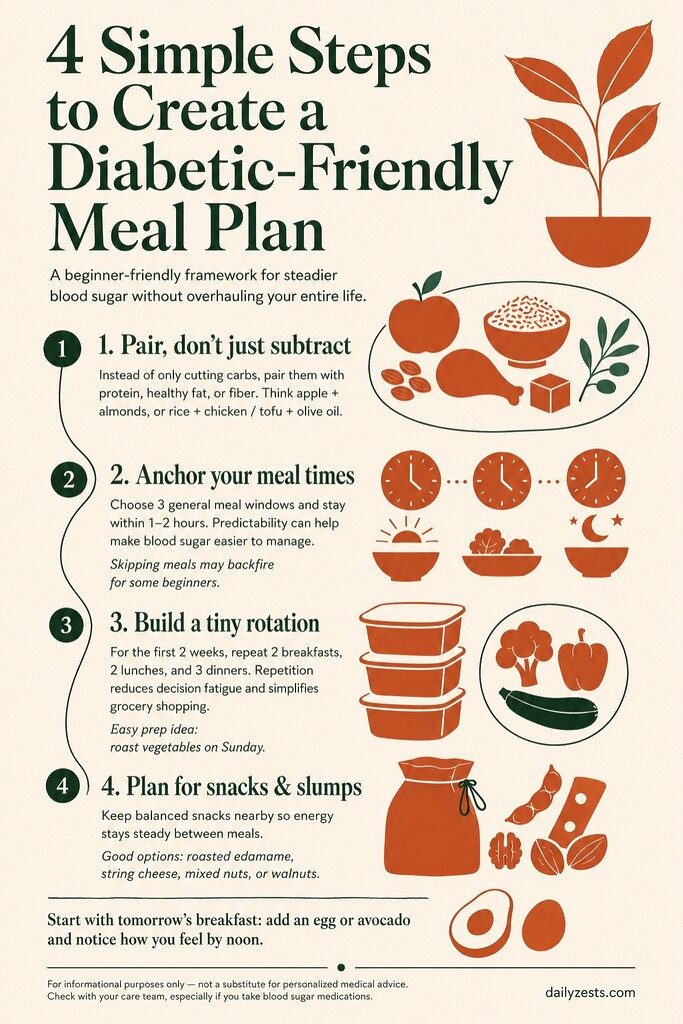
Step 1: Stop subtracting and start pairing
The biggest mistake in diabetes meal planning is focusing entirely on what to cut out. If you just remove the bread from your sandwich, you are left hungry. Instead, focus on what you need to add.
Research suggests that eating carbohydrates completely alone causes a faster spike in blood sugar. When those carbohydrates are paired with protein, healthy fat, or fiber, digestion can slow down for many people. The glucose may enter your bloodstream at a steadier pace.
If you want an apple, have the apple. Just add a handful of almonds or a spoonful of peanut butter. If you are having rice with dinner, make sure there is plenty of chicken or tofu and olive oil alongside it. You are building a buffer.
Step 2: Anchor your eating times
Your body loves predictability. When you eat at wildly different times every day, your blood sugar can become much harder to manage.
A lot of wellness advice out there heavily pushes intermittent fasting. Actually, wait, let me be clearer about that. Fasting does work well for some people in specific situations. But if you are just starting to balance your blood sugar, skipping meals can backfire into intense hunger and a bigger spike later when you finally do eat.
Pick three general windows for your meals and try to stick to them within an hour or two. This trains your body to know when fuel is coming. It also makes a diabetic diet meal plan easier to execute because you are not deciding when to eat, only what to pull out of the fridge.
Step 3: Build a tiny, boring rotation
Nobody has the energy to cook twenty-one unique meals a week. Trying to do so is the fastest way to abandon your new habits and order a pizza.
For your first two weeks, pick just two breakfasts, two lunches, and three dinners. Rotate them. Repetition is the secret to making a meal plan stick. It limits decision fatigue and cuts your grocery bill down significantly.
A practical starting point is roasting two large sheet pans of vegetables on Sunday afternoon. Toss broccoli, bell peppers, and zucchini in olive oil, salt, and garlic powder. Roast them at 400 degrees Fahrenheit for twenty-five minutes. Keep them in a glass container in the fridge to throw into your morning eggs, add to a lunchtime salad, or serve as a side at dinner.
Step 4: Plan for the snacks and the slumps
You will get hungry between meals. You will have a day where lunch just was not filling enough. Planning for these moments is what separates a rigid diet from a sustainable lifestyle.
I highly recommend keeping an emergency stash of balanced snacks in your car, your desk, or your bag. Roasted edamame, string cheese, or a small bag of mixed nuts can bridge the gap. I personally keep a jar of walnuts in my kitchen cabinet so I never have to think twice when I need something quick before taking my dog Barnaby for a walk.
A snack is not a failure of willpower. It is just a tool to keep your energy steady.
Start with tomorrow’s breakfast. Add an egg or some avocado to what you usually eat, and notice how your body feels by noon.
Kristina Hanson is an independent wellness researcher and the founder of DailyZests. She specializes in translating nutritional science into simple, delicious recipes that fit into real life. When she isn’t in the kitchen, you’ll find her hiking the trails or enjoying a slow morning coffee with her Golden Retriever, Barnaby. Read her full story.
This article is really informative and well-structured, but I’m struggling with the idea of completely cutting out simple carbohydrates. I have a sweet tooth, and the thought of never having dessert again is quite depressing. Are there any healthier ways to satisfy sweet cravings without completely derailing my blood sugar control? Also, I’m curious about the 40/30/30 macronutrient split. I’ve mostly heard about lower-carb approaches for diabetes. Why is this specific ratio recommended in the article?
Hi Sarah, you’re not alone in finding it difficult to give up sweets entirely! The good news is that you don’t necessarily have to. It’s about moderation and making smarter choices. For example, you can enjoy a small piece of dark chocolate (70% cocoa or higher) which is lower in sugar and higher in antioxidants. You can also try making desserts with natural sweeteners like stevia or monk fruit, or using fruit as a natural sweetener. There are many recipes available online for diabetes-friendly desserts. The key is to be mindful of portion sizes and how your blood sugar responds. Regarding the 40/30/30 ratio, it’s presented as a general guideline, and individual needs can vary. While lower-carb approaches (like getting 20-30% of calories from carbs) can be very effective for some people with diabetes, others may find them too restrictive or difficult to maintain long-term. The 40/30/30 split provides a moderate approach, emphasizing complex carbohydrates over simple ones, while still allowing for a balanced intake of protein and healthy fats. Research is mixed on which is definitively best, and recent studies suggest that a variety of macronutrient ratios can be beneficial, depending on the individual’s preferences and health conditions. Ultimately, the best approach is the one you can stick to and that helps you achieve your blood sugar goals. It’s important to work with your healthcare team to determine the right macronutrient distribution for you.
I’m overwhelmed by the idea of planning all my meals and snacks in advance. It seems like a lot of work, especially with my busy schedule. Do you have any tips for making meal planning more manageable? Also, I’m a bit confused about the role of a registered dietitian (RD) versus a certified diabetes educator (CDE). Are they the same thing, and how do I know which one I should see?
Hi Emily, meal planning can definitely feel overwhelming at first, but it gets easier with practice! You don’t have to plan every single meal and snack for the entire week right away. Start small by planning just your dinners or lunches for the next few days. You can also try batch cooking on the weekend, so you have meals ready to go during the week. There are also many resources available online, such as meal planning templates and apps, that can help simplify the process. As for your question about RDs and CDEs, they are both valuable members of your healthcare team, but they have different roles. A Registered Dietitian (RD) is a food and nutrition expert who has completed a bachelor’s degree, a supervised practice program, and passed a national exam. They can provide general nutrition counseling as well as medical nutrition therapy for various conditions, including diabetes. A Certified Diabetes Educator (CDE) can be a registered nurse, dietitian, pharmacist, or other healthcare professional who has specialized training and passed an exam in diabetes education. They can teach you about all aspects of diabetes self-management, including meal planning, blood sugar monitoring, and medication management. Many RDs are also CDEs. You might see one or both, depending on your needs. Your doctor can help you determine which professional is right for you.
This all sounds great in theory, but it feels SO overwhelming! I was just diagnosed, and now I feel like I need a PhD in nutrition just to eat breakfast. “Macronutrient distribution”? “Glycemic variability”? It’s like learning a whole new language! And honestly, the idea of giving up my morning bagel makes me want to cry a little. Is there a simpler way to get started without feeling like I have to become a dietitian overnight? Maybe a “Diabetes for Dummies” version? LOL!
Hi Barbara, I totally hear you! It’s completely normal to feel overwhelmed, especially after a new diagnosis. It is like learning a new language, but it doesn’t have to be complicated. Think of it this way: you don’t need to be a mechanic to drive a car, right? Same here. You don’t need to be a dietitian to eat healthier. Start small. Instead of a bagel, maybe try whole-wheat toast with avocado or a scrambled egg. Focus on adding more veggies to your meals and cutting back on sugary drinks. Small changes add up! And please, don’t hesitate to ask your doctor or a registered dietitian for help. They can provide simple, practical tips tailored to you. There are also many great resources online, and many apps to help with understanding your condition and the best ways to treat it. You’ve got this!
I’ve been living with diabetes for years, and I’m still struggling to find a meal plan that I can stick to. It’s so hard to resist cravings, especially when I’m stressed or tired. And don’t even get me started on social gatherings! It’s like a minefield of temptation. I also find that tracking everything so meticulously is exhausting. Any tips on how to deal with these cravings and social situations without feeling deprived or like I’m constantly monitoring myself? I need something practical, not just theoretical.
Hi Patricia, You’re definitely not alone! Many people with diabetes struggle with cravings and social situations. It’s a marathon, not a sprint, and it’s okay to have slip-ups. For cravings, try to identify your triggers. Is it stress? Boredom? Once you know what’s causing them, you can find healthier ways to cope. Maybe it’s a quick walk, calling a friend, or having a cup of herbal tea. As for social gatherings, planning ahead is key! Eat a healthy snack before you go, so you’re not starving. Offer to bring a dish that you know is diabetes-friendly. And don’t be afraid to say “no, thank you” to foods that don’t fit your plan. You can also indulge in moderation – a small slice of cake won’t derail your progress. As for tracking, it doesn’t have to be meticulous forever. Once you get a good sense of portion sizes and how different foods affect your blood sugar, you can rely more on your intuition. Think of it as training wheels – you use them until you learn to balance, then you can take them off. There are also many great resources online to help with cravings and social eating.
Okay, this article makes it sound so easy – like I just waltz into a magical garden of healthy food and poof! I’m a diabetes-friendly meal-planning master. But what about cravings? What about when I’m at a birthday party and there’s a giant chocolate cake staring me in the face? Or when I’m stressed and all I want is a big bowl of pasta? Are you saying I can never eat cake again? Also ’embrace variety’? My version of variety is switching between different types of takeout! Any tips for those of us who are not exactly culinary geniuses?
Hi Sani, thanks for your comment! You’re right; it’s not always a walk in the park (or a magical garden!). Cravings are totally normal, and it’s unrealistic to expect anyone to give up their favorite foods entirely. The key is moderation and planning. It’s okay to indulge in a slice of cake occasionally, especially if you plan for it and adjust your other meals accordingly. For stress eating, try to find healthier coping mechanisms, like going for a walk or calling a friend.
And about variety – I hear you! Not everyone is a natural chef. Start small. Try adding one new vegetable to your diet each week. Look for simple recipes online or in diabetic-friendly cookbooks. There are tons of easy and delicious meals that don’t require advanced cooking skills. The important thing is to find what works for you and make gradual changes that you can sustain over time. And remember, it’s a journey, not a race!
This all sounds great, but it also sounds expensive! Healthy food always seems to cost more than junk food. And what about all that time spent planning, prepping, and cooking? I’m a busy working mom. Also the ‘macronutrient distribution’ part has me completely lost. 40% carbs, 30% protein, 30% fat… how am I supposed to figure that out? Do I need a calculator and a food scale every time I eat? My head is spinning! Is there an easier way to approach this without getting a degree in nutrition?
Hi Emi, I totally understand your concerns! Eating healthy on a budget can be a challenge, but it’s definitely doable. Look for sales on produce, buy in bulk when it makes sense, and consider frozen fruits and vegetables, which are just as nutritious as fresh and often cheaper. As for time, meal prepping can be a lifesaver. Set aside a few hours on the weekend to cook a big batch of grains, roast some veggies, or prepare some lean protein.
And don’t worry about the macronutrient percentages too much in the beginning. Focus on the basics: filling half your plate with non-starchy vegetables, a quarter with lean protein, and a quarter with whole grains or starchy vegetables. 1 Your healthcare team or a registered dietitian can help you fine-tune the details, but don’t let the numbers overwhelm you. Start with the general guidelines, and you’ll be well on your way to a healthier diet. You don’t need a degree in nutrition to make positive changes, just a willingness to learn and experiment!



 This post may contain affiliate links.







This article is really informative and well-structured, but I’m struggling with the idea of completely cutting out simple carbohydrates. I have a sweet tooth, and the thought of never having dessert again is quite depressing. Are there any healthier ways to satisfy sweet cravings without completely derailing my blood sugar control? Also, I’m curious about the 40/30/30 macronutrient split. I’ve mostly heard about lower-carb approaches for diabetes. Why is this specific ratio recommended in the article?
Hi Sarah, you’re not alone in finding it difficult to give up sweets entirely! The good news is that you don’t necessarily have to. It’s about moderation and making smarter choices. For example, you can enjoy a small piece of dark chocolate (70% cocoa or higher) which is lower in sugar and higher in antioxidants. You can also try making desserts with natural sweeteners like stevia or monk fruit, or using fruit as a natural sweetener. There are many recipes available online for diabetes-friendly desserts. The key is to be mindful of portion sizes and how your blood sugar responds. Regarding the 40/30/30 ratio, it’s presented as a general guideline, and individual needs can vary. While lower-carb approaches (like getting 20-30% of calories from carbs) can be very effective for some people with diabetes, others may find them too restrictive or difficult to maintain long-term. The 40/30/30 split provides a moderate approach, emphasizing complex carbohydrates over simple ones, while still allowing for a balanced intake of protein and healthy fats. Research is mixed on which is definitively best, and recent studies suggest that a variety of macronutrient ratios can be beneficial, depending on the individual’s preferences and health conditions. Ultimately, the best approach is the one you can stick to and that helps you achieve your blood sugar goals. It’s important to work with your healthcare team to determine the right macronutrient distribution for you.
I’m overwhelmed by the idea of planning all my meals and snacks in advance. It seems like a lot of work, especially with my busy schedule. Do you have any tips for making meal planning more manageable? Also, I’m a bit confused about the role of a registered dietitian (RD) versus a certified diabetes educator (CDE). Are they the same thing, and how do I know which one I should see?
Hi Emily, meal planning can definitely feel overwhelming at first, but it gets easier with practice! You don’t have to plan every single meal and snack for the entire week right away. Start small by planning just your dinners or lunches for the next few days. You can also try batch cooking on the weekend, so you have meals ready to go during the week. There are also many resources available online, such as meal planning templates and apps, that can help simplify the process. As for your question about RDs and CDEs, they are both valuable members of your healthcare team, but they have different roles. A Registered Dietitian (RD) is a food and nutrition expert who has completed a bachelor’s degree, a supervised practice program, and passed a national exam. They can provide general nutrition counseling as well as medical nutrition therapy for various conditions, including diabetes. A Certified Diabetes Educator (CDE) can be a registered nurse, dietitian, pharmacist, or other healthcare professional who has specialized training and passed an exam in diabetes education. They can teach you about all aspects of diabetes self-management, including meal planning, blood sugar monitoring, and medication management. Many RDs are also CDEs. You might see one or both, depending on your needs. Your doctor can help you determine which professional is right for you.
This all sounds great in theory, but it feels SO overwhelming! I was just diagnosed, and now I feel like I need a PhD in nutrition just to eat breakfast. “Macronutrient distribution”? “Glycemic variability”? It’s like learning a whole new language! And honestly, the idea of giving up my morning bagel makes me want to cry a little. Is there a simpler way to get started without feeling like I have to become a dietitian overnight? Maybe a “Diabetes for Dummies” version? LOL!
Hi Barbara, I totally hear you! It’s completely normal to feel overwhelmed, especially after a new diagnosis. It is like learning a new language, but it doesn’t have to be complicated. Think of it this way: you don’t need to be a mechanic to drive a car, right? Same here. You don’t need to be a dietitian to eat healthier. Start small. Instead of a bagel, maybe try whole-wheat toast with avocado or a scrambled egg. Focus on adding more veggies to your meals and cutting back on sugary drinks. Small changes add up! And please, don’t hesitate to ask your doctor or a registered dietitian for help. They can provide simple, practical tips tailored to you. There are also many great resources online, and many apps to help with understanding your condition and the best ways to treat it. You’ve got this!
I’ve been living with diabetes for years, and I’m still struggling to find a meal plan that I can stick to. It’s so hard to resist cravings, especially when I’m stressed or tired. And don’t even get me started on social gatherings! It’s like a minefield of temptation. I also find that tracking everything so meticulously is exhausting. Any tips on how to deal with these cravings and social situations without feeling deprived or like I’m constantly monitoring myself? I need something practical, not just theoretical.
Hi Patricia, You’re definitely not alone! Many people with diabetes struggle with cravings and social situations. It’s a marathon, not a sprint, and it’s okay to have slip-ups. For cravings, try to identify your triggers. Is it stress? Boredom? Once you know what’s causing them, you can find healthier ways to cope. Maybe it’s a quick walk, calling a friend, or having a cup of herbal tea. As for social gatherings, planning ahead is key! Eat a healthy snack before you go, so you’re not starving. Offer to bring a dish that you know is diabetes-friendly. And don’t be afraid to say “no, thank you” to foods that don’t fit your plan. You can also indulge in moderation – a small slice of cake won’t derail your progress. As for tracking, it doesn’t have to be meticulous forever. Once you get a good sense of portion sizes and how different foods affect your blood sugar, you can rely more on your intuition. Think of it as training wheels – you use them until you learn to balance, then you can take them off. There are also many great resources online to help with cravings and social eating.
Okay, this article makes it sound so easy – like I just waltz into a magical garden of healthy food and poof! I’m a diabetes-friendly meal-planning master. But what about cravings? What about when I’m at a birthday party and there’s a giant chocolate cake staring me in the face? Or when I’m stressed and all I want is a big bowl of pasta? Are you saying I can never eat cake again? Also ’embrace variety’? My version of variety is switching between different types of takeout! Any tips for those of us who are not exactly culinary geniuses?
Hi Sani, thanks for your comment! You’re right; it’s not always a walk in the park (or a magical garden!). Cravings are totally normal, and it’s unrealistic to expect anyone to give up their favorite foods entirely. The key is moderation and planning. It’s okay to indulge in a slice of cake occasionally, especially if you plan for it and adjust your other meals accordingly. For stress eating, try to find healthier coping mechanisms, like going for a walk or calling a friend.
And about variety – I hear you! Not everyone is a natural chef. Start small. Try adding one new vegetable to your diet each week. Look for simple recipes online or in diabetic-friendly cookbooks. There are tons of easy and delicious meals that don’t require advanced cooking skills. The important thing is to find what works for you and make gradual changes that you can sustain over time. And remember, it’s a journey, not a race!
This all sounds great, but it also sounds expensive! Healthy food always seems to cost more than junk food. And what about all that time spent planning, prepping, and cooking? I’m a busy working mom. Also the ‘macronutrient distribution’ part has me completely lost. 40% carbs, 30% protein, 30% fat… how am I supposed to figure that out? Do I need a calculator and a food scale every time I eat? My head is spinning! Is there an easier way to approach this without getting a degree in nutrition?
Hi Emi, I totally understand your concerns! Eating healthy on a budget can be a challenge, but it’s definitely doable. Look for sales on produce, buy in bulk when it makes sense, and consider frozen fruits and vegetables, which are just as nutritious as fresh and often cheaper. As for time, meal prepping can be a lifesaver. Set aside a few hours on the weekend to cook a big batch of grains, roast some veggies, or prepare some lean protein.
And don’t worry about the macronutrient percentages too much in the beginning. Focus on the basics: filling half your plate with non-starchy vegetables, a quarter with lean protein, and a quarter with whole grains or starchy vegetables. 1 Your healthcare team or a registered dietitian can help you fine-tune the details, but don’t let the numbers overwhelm you. Start with the general guidelines, and you’ll be well on your way to a healthier diet. You don’t need a degree in nutrition to make positive changes, just a willingness to learn and experiment!